0
0

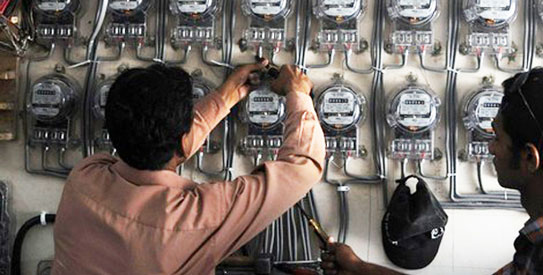
ISLAMABAD: With third party auditors identifying Rs391 billion worth of power sector losses solely because of mismanagement and inefficiency, the government has decided to gradually increase electricity tariff by six per cent during current financial year and 15 per cent next year.
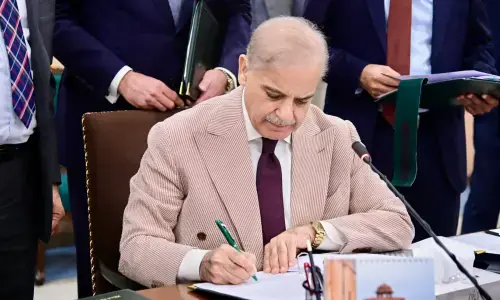
A senior government official told Dawn on Thursday that a notification for a two per cent increase in power tariff cleared by the prime minister was being vetted by the law ministry. It will be deemed to have taken effect on April 15.
The hike will be followed by another two per cent increase each for the current month and then June.
The official said the estimates agreed with international lenders suggested that the government would have to raise power tariff by about 15 per cent, or Rs1.51 per unit, to recover the full cost of electricity service delivery.
Sources said the technical, operational and management audits conducted under the US-funded power distribution improvement programme had been submitted to the government. The reports contain “startling revelations”, a source said.
The audits for the distribution companies have been completed by International Resource Group and that of generation companies by Haigler Bailly Pakistan.
The reports have been finalised after at site verification of plants, equipment, distribution network and interviews with heads of power companies.
The two sets of reports suggest that Pakistan’s power sector (excluding KESC) was losing over Rs391.6 billion every year mostly because of mismanagement.
These estimates do not indicate how much these losses may be affecting the national economy.Of this amount, about Rs158.6 billion is going down the drain every year solely because of mismanagement.
Analysis of the reports suggested that the power companies have been over-billing consumers and as a result about Rs110 billion could never be recovered.
For example, the power companies were showing about Rs30 billion receivables from permanently disconnected connections for more than three years. This could not be recovered now.
Secondly, the power companies have shown arrears of about Rs80 billion against consumers who have been defaulting on payments for upto three years.
These receivables have been found fictitious on the ground that power supplies are required to be disconnected in case of non-payment of bills after a month while these connections continue to consume electricity even after three years of non-payment.
Importantly, more than Rs160 billion receivables have been shown against private sector consumers who could not go on to use electricity if they fail to pay their bills regularly.
The findings of these reports suggest that a generation capacity of about 1500MW has completely been lost because of mismanagement whose capital cost has been estimated at Rs135 billion.
In addition to this capacity loss, another five per cent of generation is lost every year because of inefficiency. This translates into an annual loss of Rs9 billion.
The audit reports have also revealed that an amount of Rs102 billion was being lost because of extra use of fuel due to inefficient plants which should have been replaced many years ago. Another Rs10 billion has been lost to leakage of fuel supply.
These reports have reached the conclusion that besides the 20 per cent distribution losses reported by Pepco, the computed technical losses have averaged around eight per cent besides two per cent administrative losses. The reports suggest that about 10 per cent of these losses could be immediately reduced in less than a year, resulting in saving of Rs60 billion every year.