59
59

It is 11 am in the morning but the hands of the clock that hangs on Karim Hachani’s wall in his office in Karimabad, Hunza Valley, shows 9 am and it seems as though the hands of clock have stopped moving altogether.
I ask Hachani about this. He shrugs and instead, offers me chai.
Hachani, who has been a tourist guide for the Hunza Guides Pakistan for more than 15 years, tells me about the lack of tourism-related business. “It’s difficult to put food on the table now,” laments the 44-year-old father of two. His own father had been a trekking guide as well.
In the heydays, Hachani would bring groups of tourists on trekking expeditions to base camps, often stretching several days. Now, he is contemplating switching jobs.
Behind him, a pinned-up corkboard bears several letters of gratitude, some in French, German and Spanish. One of them, dated 2004, came from a group of university students from my home country, Singapore, thanking him for his “excellent” service.
And just like the hands of the clock on his wall, Pakistan’s tourism industry, has come to a standstill.
Often known as “Switzerland of the East”, the northern areas of the country are home to some of the world’s tallest peaks such as K2, Nanga Parbat and the Hindu Kush.

Admittedly, the northern areas are not for the faint-hearted. The rugged terrains, steep gorges and the harsh Karakoram Highway that cuts across mountains make for quite a perilous journey, one that appeals to those seeking an adventure.
From the ’70s up until the ’90s, Pakistan was a popular destination for European travelers who reveled in tracing the steps of notable travelers and historic figures such as Alexander the Great. But the onslaught of military operations in the country has led to falling numbers of tourists.
A few cups of chai later, I bid goodbye to Hachani who has offered to take me to the old village of Ganish the next day.
I step out onto the empty streets, lined with tall poplar trees. Signs in a myriad of languages like Korean and Japanese greet me, a vestige of what Hunza used to be – a thriving tourist destination. Hotels and backpacker inns stand empty. Rooms now come cheap. I pay just Rs.100 a night for a single bed at the Karimabad Inn.
Around me, houses sit on neat, terraced valleys blanketed in hues of yellow and green from the maize and wheat plantations.

Hunza, standing at around 8, 500 feet high (roughly 2, 440 meters above sea level) is also flanked by mountains from all sides, the most famous one being Rakaposhi, the 27th highest in the world measuring at more than 25, 000 feet.
And every year, around June, seasonal fruits such as peaches, apricots, cherries and mulberries hang heavy from the trees.
I make my way to the Baltit Fort, strolling down the carefully paved walkway but not before I am distracted by the array of hand-woven carpets (made with vegetable dyes) on display outside some shops. Colourful traditional costumes, pashmina shawls and wooly hats are also on display.
A shopkeeper beckons to me and I enter the shop – probably the first one to do so in days.
An hour later, I walk out the shop with some shopping bags. I bought a vest with peacock motifs (I have yet to find an occasion to wear the somewhat outlandish vest) and a few topi (hats) as souvenirs for people back home. As I continue down the sleepy street, another shopkeeper calls out to me. A few minutes later, I walk out of the shop with a new blue lapis pendant around my neck and ruby earrings.
The time I was in Hunza, the town was in the spotlight for different reasons. The visitors include members of the local media, going around in their newsvan, eager to capture the Attabad lake crises. For months since January 2010, due to a landslide, the lake has threatened to burst. And it finally did so in early June.
As a result, houses and shops were flooded and some 6, 000 people were displaced.
Every half and hour or so, the loud whirring of helicopter blades is heard and schoolchildren in caps emblazoned with the word “Pakistan” would look up and point to the chopper flying overhead.
On my third day there, I befriended some journalists who offered to take me with them on their reporting trip. In Aliabad (another town in Hunza), the Pakistan Army has taken over the Federal Government Degree College for boys and converted it into an army camp of sorts. A military helicopter stands in the middle of what used to be a playing field, waiting to carry officials and rescued villagers.
After an hour or so of negotiations, I was denied a pass to board the chopper, owing to my status as a foreigner. But what I went through was nothing compared to the residents of Hunza.
Outside the compound, relief tents have been set up where stranded residents wait patiently, usually on days end. In the days that followed, boat services were carried out.
But the people of Hunza are a resilient bunch.

Once ruled by a prince, the population of 60, 000 are known for their peace-loving nature (the last battle was fought in 1889 against the British) and their longevity that stems from their healthy diet of unprocessed food. The fair-skinned residents are still speaking the native language of Burushaski.
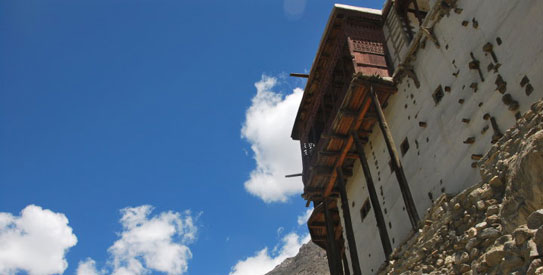
“Yahan bohut sukkun zindagi hai (Life is very peaceful here),” says Ahmad, my guide at the 800-year-old Baltit Fort as he gave me a tour of the place that has been restored remarkably well.
Traditions dating back centuries are still being practiced in Hunza. My visit to Ganish village with Hachani reaffirmed this. The village, proclaimed a UNESCO World Heritage Site, is home to Hunza’s artisan community. A few days shy of the upcoming festival of Ginani that marks the start of spring, artists with feathers in their topi are seen around the village rehearsing for a show that will be attended by Hunza’s royalty.
At night, the melodic sound of flutes being played followed by a continuous chorus of singing echoes across the town whose streets are illuminated by the moonlight.
Charmed by the peace and serenity that pervades Hunza, I stayed on in Hunza for a few more days. Quiet afternoons were spent in the popular Café de Hunza enjoying coffee and walnut cake while perusing books left behind by other tourists. At night, I would sit among the locals in the eateries around town to watch the FIFA World Cup matches.
Alberto, the Spaniard I met in the inn has likened my extension in Hunza to the Spanish saying of “mañana, mañana” (meaning: tomorrow, tomorrow which denotes procrastination). Another backpacker I met was Pierre, a French tourist whose injured ankle had stalled his trekking expedition to the Rakaposhi base camp. Fellow Frenchman Aly Bossin, who is married to a Pakistani, has also brought his family of six to vacation here all the way from Hyderabad.
One afternoon, as I was walking around, 15-year-old Naila – a local – approached me and invited me over to her house for chai. Along the way, I volunteered to carry the heavy basket of grass that her mother was balancing on her back. Naturally, I could only manage a few metres.
Her house sits on top of a hill and getting there meant having to cross streams and slippery rocks. Her house was scarcely furnished except for a few mattresses laid out on the cold stone floor – typical of a Hunza home.
Over chai and biscuits, we conversed in our broken Urdu and English (her’s was pretty good) while her nani (grandmother) placed a topi on my head and her sister danced for us. They posed for some pictures and made me promise that I would mail it to them (I have yet to follow through on my promise!). And typical to Pakistani hospitality, she wanted me to spend the night there but I politely declined and made my way back to the hostel. Amazingly, even today, we have continued to keep in touch through regular phone calls.
Earlier in the day, I woke up before the crack of dawn to follow Ilyas, a local trekking guide, who speaks fluent Japanese, to catch the sunrise from high up in the mountains. A 45-minute jeep ride and 20 minutes of trekking later, I arrive at the peak of Eagles Nest. The cold thin air makes me numb but I quickly recover as I watch alpine light being casted onto the snowy peaks of the surrounding mountains.
On my last night in Hunza, the local reporters I befriended organised a cultural night. The tourists from the inn and myself were treated to hours of revelry as musicians played traditional Hunza music accompanied by local dancers.
Tourism may have dipped but clearly, the heart of Hunza remains intact. Forts restored to great care and traditions are still being practiced as they have been for centuries.The next day, I finally left the town to continue my way to other places in the northern areas of Pakistan, eager to capture more life in these remote mountains while knowing very well that Hunza has enthralled me deeply.

Five things to do in Hunza:
1) Check out the 800-year-old Baltit Fort and Sacred Rocks with drawings depicting events in Hunza dating back to the 1st century 2) Visit Ganish village and attend a cultural event 3) Trek to Rakaposhi base camp 4) Enter China via Khunjrab Pass, also called Zero Point 5) Don’t forget to bring home a piece of Hunza, for a start you should check out shops that carry embroidered and beaded purses from Thread Net Hunza, a non-profit organisation that empowers women in northern areas of Pakistan
How to get to Hunza (Best time to visit would be anytime between the summer and spring months of April-July)
1) By air: Pakistan International Airlines flies daily to Gilgit from Islamadad, tickets cost around 3, 000 -5, 000 rupees. Passengers will be able to enjoy an aerial view of the mountains. Flight time is about 45 minutes. 2) By land: Bus companies like NATCO and Mashabrum carry out services daily from Rawalpindi to Gilgit with tickets starting from 1, 000 rupees, journey time is around 20 hours. 3) From Gilgit, vans transport passengers every hour or so (in the morning) to places in Hunza like Karimabad and Aliabad. Tickets are as cheap as Rs 300 and journey time is approximately 5 hours.
For more information check out Apna Ganish and Lonely Planet
*This is the first part of a three-part series of travel musings by the writer.
Syafiqah Omar has spent six months in Karachi interning at Dawn.com in 2010. Now back home in Singapore, she is still interested in Pakistani affairs. More than anything, she wants to dispel the notion that Pakistan is “dangerous” and wishes that many would be drawn to this beautiful country.
She would like to believe she understands cricket and speaks some Urdu. You may contact her at syafiqah.omar@gmail.com.