0
0

LASHKAR GAH: When Afghan President Hamid Karzai said Lashkar Gah would be among the first places to transition from foreign to Afghan security control in July, some observers saw it as a gamble.
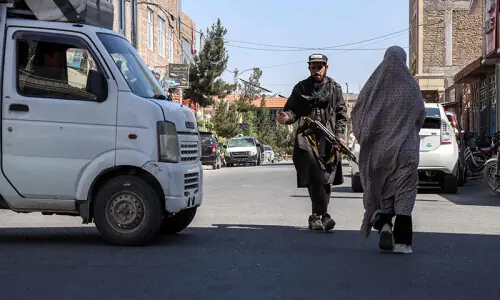
The town, laid out in the 1950s by Americans working on a river irrigation project but now a mass of mud brick houses, shops and camel trains, is capital of Helmand province, which has seen some of Afghanistan's worst fighting.
Although relatively peaceful itself, it is close to many of the country's most notorious battlegrounds, such as Sangin, and areas with virtually no government presence.
But with two months to go until July, Afghan police are already the major security presence on the streets, although they are a long way from being the finished product, experts and trainers say.
“Previously the police treated us bad. Now they know their job and treat us better,” said Mohammad Essa, a 27-year-old from Lashkar Gah.
“But I'm not certain if the police can take charge of the security of the country after ISAF (US-led Nato forces) leave.” Other observers say the situation highlights how the July handover date is largely symbolic as Western officials increasingly emphasise 2014, when foreign combat troops are due to withdraw, as the real litmus test for Afghanistan.
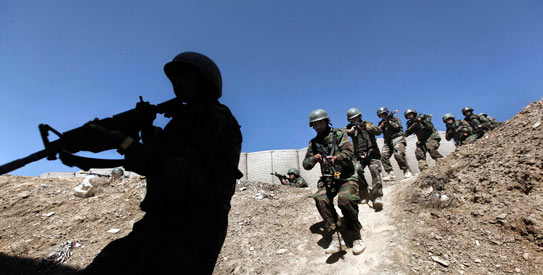
The Afghan police force, which along with the army will take increasing control of security ahead of 2014, is currently 126,000-strong and growing fast.
However, there are serious questions over their capabilities.
A report by the British charity Oxfam published Tuesday was the latest to highlight abuses and a lack of accountability among army and police, and questioned their readiness to take over by 2014.
Afghan police undergo initial training lasting just eight weeks.
At one of the country's regional training centres, in Lashkar Gah, international trainers said many of those receiving the training had already been in the force for years.
They added that while the recruits were enthusiastic, they were far from perfect and would continue to need help beyond July.
“They still need assistance,” said British Army Captain Raghu Birrai, the centre's second in command.
“That's really important, we can't just say from July 'you're on your own', I think that would be a big mistake.” As well as claims of abuses, problems facing the police in Helmand and across Afghanistan include widespread illiteracy – just 14 per cent of new recruits can read and write, compared to a national average of 43 per cent.
There is also a lack of trust. Just 48 percent of people in southwest Afghanistan view police favourably compared to 40 percent for the Taliban, according to a UN Development Programme survey published in January.
This can be linked to issues including corruption – in Helmand alone, five out of the 35 state prosecutors currently deal with police graft – and a frequent failure to mirror the ethnic make-up of local areas.
Western military figures say a standardised programme of instruction for police introduced in recent years is now raising standards. Oxfam said serious efforts to train up security forces only began in 2009.
And in Lashkar Gah, officials insisted the increasing role of police was a good sign for transition.
“Things have already been changing enormously and they will continue to,”said Michael O'Neill, the British head of the local provincial reconstruction team which aims to help the Afghan government build capacity.
“July 1 represents a milestone. That process of change is going to continue and it's going to spread,” he added.
Experts warn that the success or otherwise of the first wave of transition to Afghan police and military control of security in July is likely to have little impact on the overall picture in Afghanistan.
“It will be symbolic in that the US (and other foreign countries) will retain a substantial presence, it's not going to wind down very quickly,” said independent policy analyst Stephen Carter.
“If the real challenge is at a national level, of politics and government, I don't think a successful transition in one place means that much.” – AFP