0
0

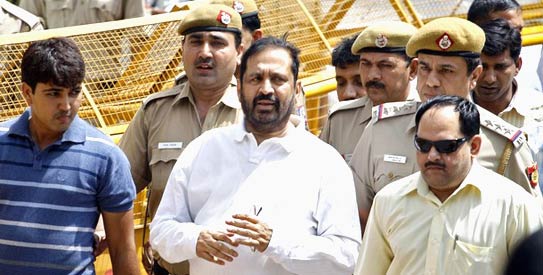
NEW DELHI: India's notorious Tihar Jail in New Delhi is currently home to a clutch of VIP inmates suspected of corruption as police win rare permission to go after the ‘big fish’ in recent cases.
The forbidding complex, home to militants and murderers, offers little in terms of comfort for its new white-collar guests, who are forced to share tiny cells with basic toilets in sweltering heat.
Prison chief Neeraj Kumar told AFP that the powerful connections of his new charges, which include the country's former telecom minister and the head of the Indian Olympic Association, have won them no special treatment.
“It's just a speculation in the media that we have a VIP jail,” Kumar said from his office at Tihar where 11,700 inmates, including 470 women and 500 foreigners, are squeezed into facilities designed to hold half this figure.
“We have not provided any special privileges to them and nor have they asked for any,” he said, before clarifying that they have been segregated from hardened criminals for their own safety.
The biggest name in custody is former minister A. Raja, who is awaiting trial over his role in what police and the national auditor believe to be one of India's biggest swindles.
Raja recently complained in court about the austere cuisine of Tihar, where special food is served “only on days of national importance,” according to the jail's official website.
Flat breads, boiled lentils, rice and vegetables is the daily staple and “the food is taken in hot cases to the wards where all inmates must queue up to eat,” Kumar said.
Raja is accused of selling telecom licences in 2008 at cut-rate prices to favoured firms, losing the state up to $39 billion and causing a scandal that has severely damaged the government of Prime Minister Manmohan Singh.
Five top businessmen, including a billionaire property developer, are also behind bars awaiting trial, and the chief organiser of last October's Commonwealth Games in New Delhi, Suresh Kalmadi, is in judicial custody.
The usual day for inmates begins at 6:00am when they present themselves for a headcount and then queue up for two pieces of bread, a plate of curry and tea for breakfast.
“There is also no question of providing coolers in their cells,” Kumar said when asked if he would oblige the VIPs, blistering in 42 degrees Celsius summer Delhi heat.
This sort of a treatment for wealthy and influential figures in a country with a strong VIP culture and long-used to the near-impunity of its top political leaders is highly unusual.
India's police are generally reluctant to go after people with connections, say campaigners, and under Indian law the prosecution of a senior bureaucrat or politician can only happen with government approval.
“It is a rarity that these luminaries are in jail, but the government was forced to take this action because of tremendous pressure to combat corruption,” said Anupama Jha, Indian head of the anti-graft watchdog Transparency International.
Under normal practice, a lower-ranking fall-guy would have been identified to do the prison time while the bosses would get away.
In the recent cases, however, the government faced demands for action from the media and sharp criticism from the country's activist Supreme Court. But it did so reluctantly, Jha says.
The sports boss, who is also a member of parliament from the ruling Congress party, was lodged in Tihar for 14 days on May 4, seven months after the shambolic Commonwealth Games.
Police are yet to formally charge him and he is to appeal for bail on Monday.
Mental health experts say influential people with extravagant tastes like Kalmadi, a regular at New Delhi's finest restaurants, would struggle to adapt to a life behind bars.
“Going from a lifestyle of freedom of economy and celebrity status to extreme conditions of a prison is a huge trauma for them,” said clinical psychologist Gunjan Ryder, who works with India's Max healthcare group.