



 3
3

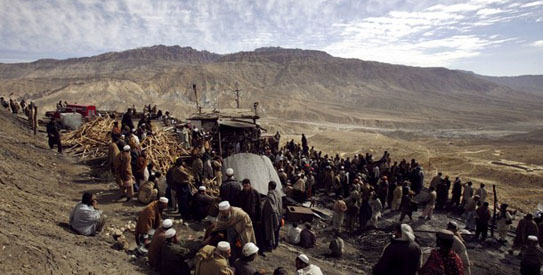
Mohammad Ilyas started working in a mine at Sorange at the age of 13 when his family fell on hard times: his father, a miner and the sole breadwinner for the family, was unable to work because of his ill health in turn caused by subhuman working conditions in the mines.
He first developed pulmonary complications from inhaling soot and dust, and then had a stroke that left him permanently paralysed. Given the absence of medical cover or other benefits for mine workers, Ilyas and his family had no one to turn to. Nor did anyone come out to help them. “We did not receive any compensation or help in my father’s treatment,” he says. “The contractor gave us 20,000 rupees but as a loan.”
With no other source of income and under debt, Ilyas followed in the footsteps of his father and those of the children from impoverished families in that coalmine rich region of Balochistan and headed for a mine to find work. In 2005, when he was just 15 years old, he lost a thumb and a finger on his left hand in a work-related dynamite explosion. Lucky to have escaped alive, he is unable to take on any task that requires dexterity with both his hands. But like his father he has received neither any compensation nor any money for the treatment for his injury. Not even a relatively easier assignment because of his disability.
In and around Sorange, there are many miners like Ilyas who started off young. Mumtaz Ali, 20, began working as a miner in 2006. Initially, his manager tasked him to do rock-blasting with dynamite so that coal could be extracted from beyond. With no knowledge or training about how to use explosives, he lost two fingers and a thumb on his right hand and a finger on his left hand when the dynamite exploded in his hands. “All expenses for my treatment were borne by my father. The contractor did not provide any help,” he complains. Having failed to find work because of his missing fingers, he is now jobless.
Such stories are common among the highly unregulated coal mining industry where underage workers – children as young as five years old and teenagers – are employed in contravention of the laws set by the Balochistan Mines Department. The Herald’s investigation reveals that children work in both government-owned and private mines in an extremely dangerous and injury-prone environment. Worse still, the authorities prefer being in a state of denial, taking no action as all this goes on under their noses.
Abdul Wadood Khan, the executive director of the Society for Empowering Human Resource (Sehr), which has made independent efforts to collect data about the children working in coalmines, says, “These children are being denied all basic rights. They are exploited economically and even physically. They are sexually abused and forced to work in hazardous conditions with their lives at high risk.” A survey that Sehr conducted in 2007 in collaboration with Sweden-based organisation Save The Children found that 437 miners employed in underground zones in six mining areas of Balochistan were under the age of 18. “Even four-five year olds work thousands of feet underground to dig coal out,” says Wadood Khan.
When the Herald asked contractors and managers of the mines in the province’s Dukki area about the alleged child labour, all except one of them outrightly denied the presence of underage workers inside the mines. They admitted that children were working in the mining sector because of the rampant poverty in the coal-mining regions but they were employed only as “mait cooleys” to sift coal from clay. One manager who admitted that children work in the tunnels says that they are paid as little as 1,500-2,000 rupees per week. “Those working as ‘mait cooleys’ get paid even less, making 4,000 rupees a month,” he says. Contractors take advantage of the fact that child labour is illegal and pay underage workers much lower than the official minimum wage, knowing that they will never move the authorities against them for fear of losing their much-needed jobs.
But whether they work inside the mines or outside, the children do not receive any special treatment in terms of working conditions. Their shift starts at sunrise and ends at sunset. Sometimes they work well into the night to earn some extra money. One mine owner, in fact, deems that employing children inside a mine is sometimes the only way to make coal extraction possible. “If a mine is less than a foot in diametre then only a child between the age of five and 10 years can work inside it,” he says without wanting to be named. While digging coal from the ceiling of the mine with his back on its floor, “the coal may fall directly into his eyes,” he says. Working in such conditions, says Wadood Khan, “can lead to a variety of disorders such as psychosis, pulmonary and chest infections and at times instantaneous death.”
He says that the government has failed to even compile data and facts about the children working in the mines, leave alone any inquiry or investigation into the issue. “So, the situation is not improving. More families are sending their children to work in the mines due to financial constraints,” he says.
The Herald is Pakistan’s premier current affairs magazine published by the Dawn Media Group every month from Karachi.


























