0
0

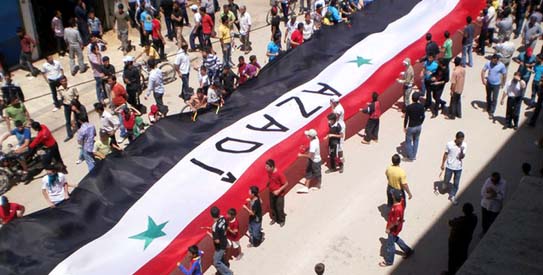
DOHA: "If you did not see the need for reform before what happened in Egypt and in Tunisia, it is too late to do any reform." Those were Syrian President Bashar al Assad's words to the Wall Street Journal two weeks before the breakout of the recent events in Syria.
The toppling of two dictators meant nothing to Syria's Assad back then. His arena was supposedly immune to all sorts of popular anger and discontent, however, the events that broke out in mid-March on the streets of Deraa and other Syrian cities and towns proved Assad’s assessment of the situation to be incorrect.
The Real Challenge
Syria's 40-year old police state had faced very few challenges in the past, the most serious one of which was the militant uprising in the northern town of Hamah in 1982. Back then, it was the Muslim Brotherhood, a fundamentalist militant group, posing a threat to the nationalist Baath Party regime led by late President Hafez al Assad. The Hamah uprising did not resonate in other areas of the country and Hafez’s younger brother, Rifaat, led the Syrian special forces into the city and managed to quell the uprising following a devastating armed conflict that left thousands dead. Ever since that date, the Assad regime has not faced any real threats besides an in-house power struggle between the Assad brothers which saw Rifaat leave the country after a failed coup d’état.
With the recent breakout of unrest in Syria, many argued that the regime’s decision to respond through the use of excessive violence was steered by Maher al Assad, the president's younger brother, in what seemed to be a reproduction of the Hafez-Rifaat relationship in its good old days.
However, the military solution of 1982 has failed to deal with the current challenge for the simple reason that today’s uprising is different in nature. As opposed to the predominantly-Islamic armed revolt of 1982, the current one is a peaceful freedom movement with no ideological motives. The regime's propaganda tools have tried so hard to portray the opposition as a "bunch of armed extremists" but failed to deliver any real evidence to validate such argument other than showing few people on the state-run Syrian TV making confessions about belonging to fundamentalist groups. To the people who are familiar with the regime's traditional ways, such footage looked so much like an inside job.
The unrest that first started in Deraa could not be contained by the security forces and ended up reaching other cities and towns, such as Lattakia, Homs, Hamah, Baniyas, and others. The regime's heavy hand in dealing with protesters in Deraa resulted in a reverse effect as people in other cities started organizing solidarity marches. The most interesting observation when it comes to mapping out the unrest is the fact that Syria’s two biggest cities, Damascus and Aleppo, did not ride the wave. Some Damascus suburbs have indeed witnessed protests but not the heart of the Syrian capital. Now, where does this take us?
Assad's Comfort Zone
A close look at the Syrian regime and its power dynamics would tell us that the two main pillars of Assad's rule are the businessmen and the military. The vast majority of the country's business class (upper middle class) is located in Damascus and Aleppo. It is common knowledge in Syria that such class enjoys strong ties with the regime as a result of a convergence of interests. It was Bashar's late father who set up this formula as well as many others to protect his rule. He was known to be a firm politician with a combination of wit and Machiavellian brilliance. Back then, his argument was: "Give the merchants what they want to stay away from politics." It worked pretty well for both father and son. Assad knows he cannot afford losing his strongholds, and unless the merchants undergo a change of heart, the fight for change in Syria will be facing serious obstacles.
The regime's other pillar is the military indeed; an institution so different in its makeup than fellow Arab armies. Most of the military's strongmen are the president's blood relatives, such as his brother Maher, the head of the presidential guard, and his brother-in-law Assef Shawkat, the deputy chief of staff and the country's former top intelligence man.
Unlike the armies of Tunisia and Egypt, who abandoned former Presidents Ben Ali and Mubarak and sided with the people, Assad's army appears to be more loyal to his person and has so far managed to keep him in fairly good shape. However, the reported deaths in military ranks have posed a serious question on whether the army was witnessing some sort of rift. The official narrative is that the soldiers were killed at the hands of armed men while the opposition’s narrative is that military deaths are an inside job too. An interesting article in The Guardian late last month cited sources as saying that some soldiers were shot at by secret security forces after refusing to follow orders. As a matter of fact, neither narrative can be confirmed in the light of the media blackout imposed by the regime.
A Call for Dialogue
A few days ago, Assad was reported to have given orders to security and armed forces not to open fire at protestors. The result was a lesser bloody day on Friday (May 13). His orders were combined with a call for dialogue with the opposition in what seems to be a move to politically contain the situation after failing to do so forcefully. The coming days will tell us if the call for dialogue would gain any momentum as many have started to feel that change in Syria has become inevitable.
Hussein Abdallah is a Doha-based media analyst and a former journalist at Beirut's The Daily Star.