0
0

LONDON: Britain could have to make tough choices about its military priorities if the Libya campaign drags on, the head of the Royal Navy said Monday, in comments that called recent defence cuts into question.
Admiral Mark Stanhope, the First Sea Lord, said Britain might have to rethink its priorities if the operation went on longer than six months.
Elements of the campaign would have been cheaper and “much more reactive” if Britain had still had an aircraft carrier, he argued.
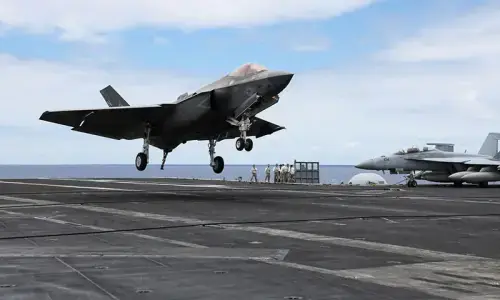
The Royal Navy's flagship HMS Ark Royal, and its Harrier jump jets, returned to base for the last time in December, leaving Britain without an aircraft carrier capable of launching jets for the next decade.
Britain's biggest active warship was axed as part of eight-percent defence spending cuts introduced by Prime Minister David Cameron's coalition government as part of its bid to get Britain's record deficit under control.
“How long can we go on as we are in Libya?” Stanhope asked at a media briefing. “Certainly in terms of Nato's current time limit that has been extended to 90 days, we are comfortable with that.
“Beyond that, we might have to request the government to make some challenging decisions about priorities.” Britain has been one of the chief players in the Nato military alliance enforcing a United Nations mandate.
Their mission is to enforce a no-fly zone and protect civilians in Libya as leader Moamer Qadhafi attempts to crush a rebel uprising.
“If we do it longer than six months we will have to reprioritise forces. That is being addressed now,” Stanhope said.
“It could be from around home waters. I will not prejudge what that decision will be.”
But the admiral pointed out that Harriers could have been deployed from an aircraft carrier in 20 minutes rather than the 90 it takes to send Tornado and Typhoon jets from an airbase in Italy.
Britain's Defence Secretary Liam Fox said however that the Strategic Defence and Security Review (SDRS), which ushered in the military cuts, would not be reopened. “Operations in Libya are showing how capable we are post-SDSR as a leading military power with the fourth largest defence budget in the world,” he said.
“We continue to have the resources necessary to carry out the operations we are undertaking and have spare capacity.
“Our planning assumptions remain valid and we have been able to effectively conduct missions over Libya. We are now progressing with the disposal of the Harrier force.”