0
0

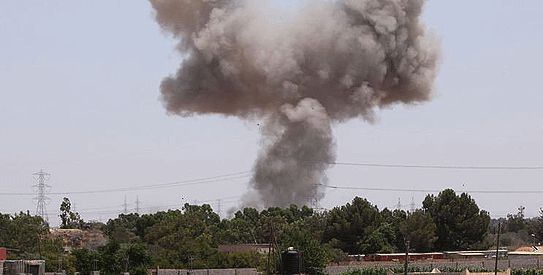
BENGHAZI, Libya: Libyan rebels on Sunday rejected an African Union peace plan, saying it would leave Moamer Qadhafi in power, as South Africa's president headed for talks in Russia on the conflict.
Dismissing the AU plan as not meeting even their basic demands, rebel spokesman Abdel Hafiz Ghoga said bluntly: “We have rejected it.” It did not include the departure of Qadhafi, his sons and his inner circle. We have repeated this (demand) on more than one occasion.”
The rejection came after the rebel army said it was poised for an offensive that could put it within striking distance of Tripoli, after French arms drops and intensified Nato air strikes on the regime's frontline armour.
Deadlock on the battlefield has prompted mounting pressure from countries outside the Nato-led coalition for a negotiated solution to a conflict that has dragged on for four and a half months.
South Africa, which has taken a lead role in mediation efforts, said that President Jacob Zuma would hold talks in Moscow on Monday with representatives of the International Contact Group on Libya as well as with Russian officials.
Russia and South Africa are both outspoken advocates of a negotiated solution to the Libya crisis.
The foreign ministry in Pretoria said the Russia talks would include all members of the International Contact Group but could provide no further details.
The announcement came shortly after Zuma returned home from the AU summit in Equatorial Guinea, where the continental grouping adopted a plan for negotiations between the warring Libyan parties.
New elements in the plan include provisions for a multinational peacekeeping force organised by the United Nations.
The AU also said that Qadhafi has agreed to stay out of the negotiations, but the 53-nation bloc was unable to take a position on his future, a key sticking point.
The agreement contained no direct criticism of Qadhafi and even called for an amnesty for crimes during the conflict and the unfreezing of Libyan assets abroad.
The African Union also decided that its members would not execute an International Criminal Court arrest warrant against Qadhafi.
That was a non-starter for Libya's rebel council, Ghoga said. “Any future proposals must not include a future (in power) for Qadhafi and his inner circle,” said Ghoga, who also tried to draw a line under apparent mixed messages from the National Transitional Council (NTC).
Rebel envoys in Europe and elsewhere had previously indicated that the rebels may be open to the talks.
Mauritanian President Mohamed Ould Abdel Aziz, head of the AU panel on Libya, on Sunday met a Qadhafi envoy, the Mauritanian news agency reported, saying without elaborating that they discussed “issues of common interest.” Meanwhile, the NTC received a boost on Sunday when Ankara accorded it de facto recognition.
“We think the Transitional National Council is the legitimate representative of the Libyan people,” visiting Foreign Minister Ahmet Davutoglu said in Benghazi.
Asked if Turkey would consider hosting Qadhafi as part of a peace agreement, he said “if there is an agreement being achieved we will do everything, everything possible.” Rebel fighters are preparing to advance from their enclave in the Nafusa Mountains southwest of Tripoli in the next 48 hours in a bid to recapture territory on the road to the capital, spokesman Colonel Ahmed Omar Bani said on Saturday.
“In the next two days the (revolutionaries) will come up with answers, things will change on the front line,” he said.
Last week, the rebels withdrew from around the plains town of Bir al-Ghanam, some 80 kilometres (50 miles) from Tripoli, after loyalist bombardment.
However, France has made a series of controversial weapons drops to rebel fighters in the Nafusa, and Nato has bombarded loyalist positions around Bir al-Ghanam and elsewhere.
In its daily report for Saturday, Nato said on Sunday it had launched 52 strike sorties over Libya, hitting a tank near Gharyan and three armoured vehicles near Zlitan, also on the Nafusa frontline.
Qadhafi reacted furiously to the French arms drops to the rebels, calling on his supporters on Friday to go and retrieve the weapons.
French Foreign Minister Alain Juppe insisted that the arms were meant only to defend peaceful civilians from Qadhafi's forces and thus fell in line with UN Security Council resolutions on the conflict.