0
0

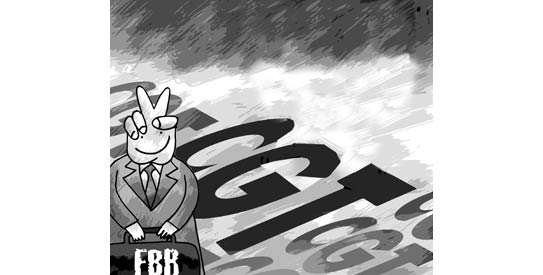
THE Federal Board of Revenue has surpassed its revenue target of Rs1588 billion for the just concluded financial year, perhaps for the first time. But it has raised the question why the only new tax initiative taken in the last year budget has failed to deliver?
Although lower than budgeted Rs1667 billion owing to devastating floods and sliding economy, the recovery in excess of revised target by about Rs3 billion so far has come about in the wake of improved compliance by the existing taxpayer-cum-smart evaders and additional taxation levied mostly again on existing income tax payers in March this year.
But what about bringing new areas into effective tax net?
The score card is depressing and will continue to remain so. No progress on tax on agricultural income, no apparent move to properly tax huge wealth in real estate, and the outcome of GST on services introduced after a lot of delay is yet to be seen.
All indications suggest a sort of fiasco on capital gain tax on stock investments introduced last year. The issue has become more relevant in the context of success or failure in bringing in new areas into tax net. A naive sort of debate is going on and on among government circles and stock market stakeholders, with no positive outcome.
The debate was triggered after an off-the-cuff remark by a government functionary during the course of talks on methodologies for collecting capital gain tax and different pressure tactics used by the market players to foil or at least dilute the impact of the new tax. It would be imprudent to think that capital markets did not have any positive impact on the economy but the hawkish comment in response to a threat to close down markets may have some relevance.
The way a stock market operates is actually the determining factor which makes it good or bad. When it operates responsibly and regulated effectively, stock market is an important institution to channel funds from surplus economic units to the deficit units, that puts the wheel of economy in motion.
However, when left to manipulations, an institution turns into a device for draining public savings into fewer hands. This is precisely what the domestic bourses seem to have done to general public over the years.
Be it India or Pakistan, intra-day traders of stock market who fell victims to the unsparing and unpredictable markets moves have left behind lessons for others to learn. An intra-day trader bets on chance and leaves himself at the mercy of the fate.
Such ‘investment’ moves into the realm of gambling. On the other hand, In a given position, if an investor bets on his stock selection skills, he hopes to reap the fruits of his wisdom.
The virtual gamblers in stock market hardly make any money in the long run. They are instead used just to fuel market movements. The investors who make calculated moves to select promising investments stand to make capital gains from these market movements.
Brokers usually compare foreign portfolio investment in the domestic stock market with that in the Indian stock market. Such investment is not something to take pride in. Foreign portfolio investment flows in quickly when the economy shows robust growth while the price bubble in a stock market is forming.
Such investment flows out even more quickly when the economy begins to stagnate and the time for the price bubble to burst is arriving fast. South East Asian currency crisis of 1997 is a vivid reminder of the questionable value of portfolio investment in a country.
Perhaps, for the first time in long history of price manipulations, insider trading, and managed crashes in stock market, the government has swung into action to put brakes on the risky market volatility. Levy of capital gain tax on stock investments should not be considered just a revenue measure. It is as much a policy tool to promote long-term investment behaviour and to curb speculative trends.
If average daily volume at the KSE has declined to Rs2.8 billion compared to average volume of Rs40 billion a day during the four years from 2005-2008, it means the levy of capital gain tax has successfully achieved its policy objective, if not revenue target.. Perhaps, the speculation is giving way to investment.
Most market participants have gained in the process except those who used to mint billions in commissions just from deceptive and manipulated wide market swings. The broker community has taught the market participants enough bitter lessons. Even government seems to have learned a great deal from the speculation-driven massacres in stock market over the years.
Market participants’ cautious approach towards stock investments and government’s policy to change investment behaviour are the outcomes of this learning process.
Stock market crashes of 2005 and 2008 sharply divided the market participants into the gainers and losers. The gainers, most of them brokers and other big market players, used these crashes artfully to drain the savings of general public. The losers, most of them retail investors, could not find any one in regulator or the government to rescue them or punish the criminals.
The brokers’ argument that greater liquidity in stock market helps price discovery, lacks any logic. In a more liquid market, speculation creeps in and the fair stocks values are buried deeper and deeper beneath the speculation driven artificial market prices.
The brokers second argument to get concessions for retail investors in CGT payments is also fallacious. Investors do not fear stock investments because the government will ask for a small part of the gains made on such investments in taxes. They fear stock investments mainly because they know for sure that, sooner or later, big market players will rob them of their life savings.
To put substance into their shallow arguments, brokers compared the domestic market capitalisation to GDP ratio with that of other countries. In case of some listed companies, free floating shares are limited. It is only the market price of share which drives the domestic market capitalization to GDP ratio. Market price of shares is in turn determined by the underlying economic growth and speculative activity in the market.
Given the fact that domestic economy is stagnating at 2.5 per cent per annum, it is the speculation which drives the domestic market capitalisation to GDP ratio. A rise in this ratio in the domestic environment is therefore a danger signal which sets the alarm bells ringing.