0
0

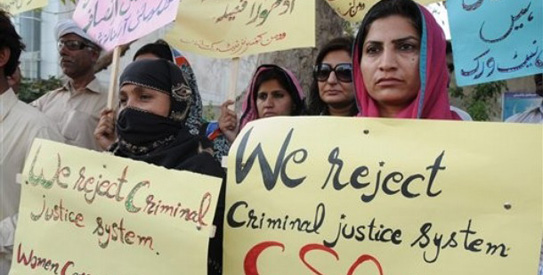
KARACHI: Special courts, tribunals and quasi-judicial forums must be abolished as these are against the constitution and tend to cause more harm than provide speedy and efficient justice, said a study on judicial systems launched on Wednesday.
Part of the set of recommendations in ‘A Study of Formal and Informal Legal Systems Prevalent in Pakistan’ conducted by the National Commission on the Status of Women (NCSW), the report was presented by NCSW chairperson Anis Haroon at a programme.
She was accompanied by retired Justice Majida Rizvi, who was the lead consultant for the report — a comprehensive account of the justice systems in Pakistan including the much-maligned parallel legal system. Also present on the occasion were Justice Kailash Nath Kohli, Sadia Mumtaz and Nasreen Azhar.
Regarding the quasi-judicial forums, the study observed that the cases should only be entrusted to the regular courts with full-time judges at the district level at the first stage. “The parallel legal forums lead to prolonged litigation as sooner or later the disputes are taken up at the judicial forums. This leads to prolonged litigation and puts the litigants in a more adverse situation.”
In 2010, the nationwide study was commissioned by the NCSW to examine these systems keeping in mind the gender issues. It was aimed at finding out whether the systems were cohesive and efficient when it came to providing justice.
The study covered the federally administered tribal areas (Fata) and Gilgit-Baltistan along with the provinces.
It focused on the formal legal system, the parallel legal system and the parallel informal and illegal system and took into account the threats that the extra-judicial systems pose to the formal justice system.
“The parallel legal system affects women the most. In a marginalised society where there is no regard for laws, this system creates chaos. What is worse is that often the reports of abuses and crimes against women are not taken up by the media,” said Ms Haroon.
Elaborating on the study and its aims, she said that it’s about time that the country did away with the parallel justice system.
“Jirga and Panchayat always end up giving a biased judgment and usually it’s the victim that receives a harrowing penalty. We need to take into account the fact that justice is the right of each and every citizen of the country and it’s only a fair legal system that can do justice.”
Citing the Haripur case where a woman was paraded naked on the orders of a jirga and another one where a woman was stoned to death in Barikot, she questioned the rationale behind this form of `justice`.
“While these are just some of the cases that come to the fore and where the police justly did its duty, there are many, many more cases that go unreported. This is particularly the case in Fata where the strong Taliban influence often leads to the swift elimination of women without a second thought,” she said.
While the incidents did get reported in Sindh and Punjab, violence against women had continued to escalate there too over the years, she added.
Speaking about Balochistan and the situation of human rights and women’s rights, Justice Kohli said the justice system needed to be reconsidered. “In 1993, the Jirga system was abolished in Balochistan but unfortunately it continues to date due to the Sardari system. Anyone going against tribal customs is considered to have committed a sin.”
He said there was a need to change the mindset but there was an even stronger need to implement laws fairly because only then would a precedent be set.
In its recommendations, the commission further stated that the number of judges should be increased in courts for speedy and better dispensation of justice and called for women judges to be a part of the decision-making process.
On the importance of providing justice to women and redress of the violation of women’s rights, the study called upon the government to take appropriate measures for better management. “Extend laws, especially the family laws and other pro-women legislation to Gilgit-Baltistan and Fata and any other territories in Pakistan not under the cover of the constitution and the law of the land,” the study recommended, laying emphasis on effective implementation of laws.