0
0

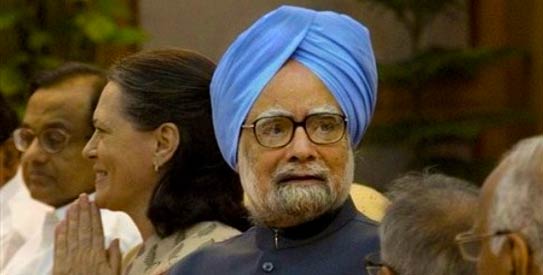
NEW DELHI: Indian Prime Minister Manmohan Singh came under renewed fire after he failed Tuesday to make sweeping changes to his cabinet in a reshuffle that the opposition branded an “aimless rotation”.
Halfway through its second term, the administration led by Singh’s Congress Party has suffered from months of bad headlines over corruption scandals, stubbornly high inflation and slowing economic growth.
The finance, home, defence and foreign affairs ministers were all unchanged, in a limited shake-up of Singh’s top team that was aimed at combating accusations that the government has badly lost momentum.
Environment Minister Jairam Ramesh was the most high-profile mover as he was promoted to the cabinet and transferred to the rural development portfolio.
Parsa Venkateshwar Rao, an independent political analyst and writer in New Delhi, said the limited changes were a missed opportunity for Singh to fulfill his vow to revive the government.
“This does not come through as an attempt to clean up the government’s image. They are practically routine changes,” he told AFP. “The prime minister promised a major reshuffle, but that hasn’t happened.” Rao added however that Ramesh’s promotion to cabinet might “bring some energy since he is a very pro-active minister.” Last month, Singh, 78, rejected criticism that he had become a “lame duck” leader who had turned a blind eye to a spate of corruption allegations, including a multi-billion-dollar telecom scandal.
The main opposition Bharatiya Janata Party (BJP) dismissed the reshuffle as an “aimless rotation” that fell far short of public expectations.
“The reshuffle clearly shows that the government does not care about popular sentiment. People expected significant changes this time,” BJP spokesman Syed Shahnawaz Hussain told AFP.
The reshuffle followed the resignation of textile minister Dayanidhi Maran last week over the 2006 allocation of second-generation (2G) mobile phone licences when he was telecoms minister.
The 2G issue has been the biggest corruption scandal to hit Singh, with allegations that the treasury missed out on $40 billion of revenue due to ministers selling the licences at bargain prices to selected firms.
Maran’s successor at the telecoms ministry, A. Raja, also resigned last year over the 2G scandal. Raja is now in custody awaiting trial along with several top government officials and business executives.
Both Maran and Raja were from the regional DMK party that is part of the ruling alliance, but the new telecoms minister was named as young Congress politician Milind Deora.
In other appointments, Dinesh Trivedi, from the Trinamool Congress regional party, took the railways post that had been held by the party’s boss Mamata Banerjee until she became chief minister of West Bengal state in May.
The railways ministry has been in the spotlight after a series of disasters.
On Sunday, nearly a dozen carriages of a packed express jumped the rails in the northern state of Uttar Pradesh killing 69 people, while a suspected bomb on the tracks in the northeastern state of Assam derailed a second train.
Last week, 38 people were killed in another rail crash in Uttar Pradesh when a train slammed into a bus carrying a wedding party.