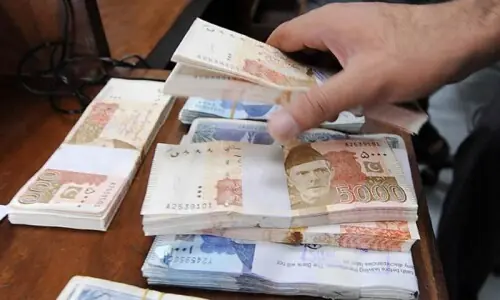
Central Bank independence and inflation
| 19th July, 2011
16

One of the main economic challenges that Pakistan has faced in the recent decades is controlling inflation in order to mitigate the effects of increasing in prices of goods and services. Time and time again, the general public has seen the value of the ruppee depreciate and suffered under the barrage of increasing prices that have not met with an increase in wages. This article will discuss and explain first why inflation occurs, with particular attention to Pakistan’s case, and then suggest how a reformed institutional setup of the State Bank of Pakistan can help assuage inflation to a considerable extent.

So, why does inflation occur? In macroeconomics, this is a topic that has been studied in great detail and with a lot of success. The widely accepted theory of why inflation occurs was first postulated by the great economist Milton Friedman who famously said, “Inflation is always and everywhere a monetary phenomenon”. The idea is simple: There is a direct positive relationship between inflation and the money supply, or the amount of currency issued or in circulation in the economy. Hence, as you increase money supply, you cause inflation. To illustrate the robustness of this theory, I graphed above the percentage increase in money supply and of inflation. Notice how, in the graph, money supply and inflation grow at almost the same rate, a testament to the power of the theory.

Now we have an understanding of the strong positive relationship between money supply growth and inflation, we ask how is it that money supply is set so high? In all modern societies, the decision on setting money supply, and hence inflation, rests in the hands of the Central Bank, or in Pakistan’s case, the State Bank of Pakistan. Historically, the money supply was pegged to an intrinsic commodity, like gold or silver, i.e. a Central Bank could only print more money if it obtained or acquired more gold or silver. This was because all currency had an inherent promise to be converted to the pegged commodity at demand by the citizenry, something you can read off old American, Pakistani and other country’s notes. This served as a commitment device that put a limit on how much money could be printed. But in the current system, Central Banks issue ‘fiat’ currency, or currency that is not backed by any intrinsically valuable commodity. What all this amounts to is that Central Banks can, now, literally ‘run the printing presses’ or set money supply arbitrarily.

Hence, any rational individual will ask: if the main cause of inflation is so simple, why doesn’t the State Bank of Pakistan just print less money to control inflation? I mean, it doesn’t take a genius to figure this out, right? The simple answer is the problem lies in the lack of independence of the State Bank. Take a look at the structure of the Central Board of Directors, the monetary policy committee that sets money supply (details here), you can see that the Secretary of the Finance Division, a member of the Pakistani Government, is a permanent voting member on the monetary committee. This is highly unusual. In the developed world, Central Banks are independent authorities with no members of the elected Government on the monetary policy committee. Our system is one in which the State Bank of Pakistan is controlled by the ruling politicians, who can and do use the State Bank’s special ability to print limitlessly as their own personal piggy bank. They print money to rationalize to the citizenry that they are taking on projects for economic development and job creation. But in paying for these projects through the limitless printing of money, what the Government fails to mention is that the limitless printing results in high inflation, a potentially bigger evil than lower economic development.

To illustrate this idea more concretely, consider the following example: the Government decides to undertake a public project but faces a paucity of funds to pay for such. In Pakistan’s case, instead of making tough and unpopular choices on where to obtain the funding, it decides to pay for this project by using the State Bank of Pakistan to print new money. But in doing so, it erodes its own currency and hence causes inflation. In most countries, Governments can not pay for the project by printing money since do not have influence on the decisions of the Central Bank. They either raise taxes or they do not undertake the project. Hence, the lack of independence of the State Bank of Pakistan fails to discipline the Government from spending and this causes inflation.

So, what have we learned? Well, we have established what inflation is, why it occurs and how its causes, in Pakistan’s specific case, are intricately related to the actions of Pakistani Government and the institutional setup of the State Bank of Pakistan.

How can this problem be tackled? The answer, as already hinted, lies in the correction of the institutional setup of the State Bank of Pakistan to provide operational independence. A helpful road map of how this setup can be corrected already exists in the form of the Bank of England Act of 1998, an Act passed by the British Government to give operational independence to the Bank of England. Obviously, I do not recommend following the British example blindly, but, in my opinion, this is a nice concrete starting point given our constitution’s historic link to the Britons’. Some transferable provisions that would apply and greatly help Pakistan are:

● Removing any, and every, elected official from the Central Board of Directors (currently the Finance Minister is a permanent member)
● Not requiring a provincial quota for members; requiring an industrial quota
● Allowing for an increase in the tenure of the Governor of the State Bank of Pakistan to allow the office to be immune from pressure of the Government; more job stability would increase reputation of the Governor’s office in the financial markets (currently the tenure is of 3 years). A nice principle might be to set tenure length that is longer than of two elected governments, so 10+ years
● legislating a ‘target inflation’ rate, that is explicitly stated in the State Bank’s charter and requiring the Governor to be answerable to Parliament when this rate is exceeded

The problem of inflation, unlike some other problems facing our country, is one that doesn’t need a huge effort to curtail. As I have argued, inflation can be greatly mitigated in Pakistan, not by doing anything magical, but by undertaking intelligent institutional and legislative changes. The new operational setup would refrain the Pakistani Government from carelessly printing money and enable the State Bank of Pakistan to undertake more prudent policies to achieve its primary goal, of the controlling inflation.

The writer is a graduate student in Economics at the University of Minnesota and a research analyst at the Federal Reserve Bank of Minneapolis. He can be reached at barl0047@umn.edu.
The views expressed herein are those of the author and not necessarily those of the University of Minnesota, Federal Reserve Bank of Minneapolis or the Federal Reserve Board.

The views expressed by this blogger and in the following reader comments do not necessarily reflect the views and policies of the Dawn Media Group.

COMMENTS

  1. Very interesting, but I have to say that the issue and its solution is not that simplistic. The problem of infaltion might be a monetary phenomeman, but in our context its solution is fiscal. As a comment pointed out above, to say that our Central Bank lacks independance just because of one government member on the monetary board is perhaps not correct. While it is true that all your recommendations will probably be helpful in increasing the independance of our central bank even further, for a real solution we need an end to the chronic and irrational fiscal deficit, which we have no way to bridge other than to rely on IFIs or printing money. Inflation might everywhere and always be a monetary phenomena, but historically speaking controlling such high and prolonged periods of inflation always required deep rooted fiscal reforms. Secondly, we have real supply side issues. The energy crisis has raised the cost of production immensely. So in nutshell no matter how independant our central bank becomes, without fixing these structural problems, inflation will continue unabated.

  2. It is an excellent article and exact to the dot.
    All the recommendation should be implemented in toto.
    Money printing is not the answer at all for any country. Rhodesia and USA are good examples. Look at the fake USA dollars nowadays afloat in the world. The legitimacy of the USA dollar is in question now and probably will take the whole capitalistic system down the gurgle soon.
    Pakistan needs sanity and correct policies.

    J Abid

  3. Nice Article: The Hypothesis author is relying on is inflation can be controlled by legislating SBP as an independent authority and isolation of political influence by removing seats. In complex dynamics of Pakistan, this alone can not solve the inflation problem. Do we really think that govt. would stop interfering SBP affairs in this manner?

  4. US is priniting money as well but they still have 1.4% inflation. Reasons for inflation in pakistan are , besides a glut of money supply, eroding value of currency, higher prices of inputs (gas and eletric which are raised by the govt. every now and then) and hoarding. Also the Govt. is trying to do away with subsidies on gas, fertilizers and else which translates into higher prices for consumers.

  5. The Secretary Finance is not an elected official, he is a member of the Civil Service. Please get your facts straight.

  6. The article presents a text book explanation of inflation based on the quantity theory of the money as prescribed by Milton Friedman. However in my opinion monetary mismanagement may not be the major contributor to inflation in Pakistan. This idea suggests that monetary mismanagement results in essentially translates into excess demand for output which in turn causes inflation. However a cursory analysis of Pakistan’s economic problems suggests a supply side model of inflation to be more accurate. Under supply side model inflation results from input prices which is this case of cost energy, raw materials and wages. Other pertinent reasons applicable in this context would be bad weather conditions, natural disasters (e.g. floods) which essential limit output. Such causes erode purchase power of income and household in turn demand higher wages which results increase in cost of production and therefore causes accelerating inflation. However it’s important to assert here that wage growth in Pakistan has always lagged behind the inflation rate. Frequent upward revisions to energy and fuel prices (and their shortage) have forced producers to inflate product prices in order to protect profit margins.
    However I don’t mean discount the importance of demand side factors. One major factor in this regard is deficit spending by government which is always keen to borrow its way out of fiscal deficit. This unfortunately is increasing cost of financing for firms relying of micro credit and running finance loans. This eventually leads to prices hikes

  7. The article misses a point. Inflation is also caused by the scarity of materials!

  8. Hi, Nice article about causes of inflation in Pakistan. I wish the Govt must follow your recommendation. I appreciate the effort, our country need such people who use their education and brain for the betterment of Pakistan.

  9. Thanks for making me understand inflation in simple words

  10. Nice article. However, you base your entire argument on the presence of one government member in the monetary board. Surely, the board contains other members. As a single member in a board, I doubt the Secretary of the Finance Division dictates policy.

    • @Waqar. Well said. Precisely my thoughts. It is said how such people can easily dazzle readers with their flawed arguments into going, "excellent article."
      Let's think on a different line, too. The US has an independent central bank, right? It does not have the corrupt politician voting in the board. So, by the author's arguments, there should be no inflation in the US. But that is not the case, so the lone corrupt voting politician on the board can not be the root cause of financial problems such as inflation. But, wait, the author himself works at the Federal Reserve Bank of Minneapolis. Of course, his arguments are tilting in favour of the flawed ways of the US Federal Reserve.
      "Great economist"? Seriously? Economists are responsible for getting the world into the mess which it is in presently. The great economists weren't able to foresee the global economic meltdown even when it was imminent. They are unable to solve the problem. Yet they are great!
      Give the SBP into the hands of the corporate thugs. Sure! The same guys who are responsible to creating shortages of wheat, sugar, edible oil, cement etc. Of course, public well being is on top of their agenda. They will certainly be fair in ruling SBP and unlike the dirty politicians will not serve their own vested interests.

    • Hi Waqar and thank you for your comment. I think your criticism is very fair, and it is one I would have dealt with if space was not a constraint.
      Although the quick answer is I can not prove, without of shadow of doubt that the Government is controlling monetary policy, there is ample evidence that this is true.
      1. Gov Kardar just yesterday resigned as the Governor of the State Bank even when he was trying to be convinced not to do so by Finance Secretary Shaikh. Dawn has reported that his bone of contention was that he wanted more freedom to enact policy and if such freedom would be provided, he would consider staying. The State Bank has, in the last 3 years, will now see 4 Governors. This is a strong signal that the Governors are unhappy with the atmosphere in which they are working, and their freedom to do their job is being curtailed.
      2. In the graph you can see the inflation is increasing hand in hand with the money supply. I also provide in the article the rationale for why an entity, in this case the Government of Pakistan, has strong incentives to push for increasing money supply. High inflation is never the objective for any reason except for the reason I mentioned, broadly commitment, and the inflation tax. Hence, I can not see rationally why the State Bank would like to pursue high inflation as a policy unless the Government wants it.
      3. The broader argument is not based on the Government official. I apologize if that was stressed too much. The broader argument is based on the Government having ability to manipulate monetary policy. South American countries in the 80s did not have Governments with members on the Monetary policy committee YET they saw rampant hyper-inflation, of the sort that we are seeing. In those countries, the Government would use all kinds of pressure to make the State Bank do its bidding. This is why I suggest that a broad set of measures need to be pursued that result in the independence of the State Bank to be established. This includes increasing tenure, removing the finance secretary, introducing target inflation, etc. One thing I didnt mention at all in the article, and might be a nice next article is use of Inflation protected securities as a way to control the printing habits of the governments. this is a long and complicated argument so i wont go into it.
      Hopefully this helps explain what I was trying to convey.

  11. It is very difficult for the central bank to prevent the government from printing money unless the government agrees to set norms. In the US, inflation is not a problem in spite of the government printing money heavily and borrowing it as bonds. Now they can not issue bonds further as the limit has been reached and there is a major crisis. in India and China, the governments did not print money excessively but spent heavily to avoid slow down during 2009-10 and the result is inflation. Apart from what the economists say, inflation is a factor of demand and supply and when demand is more, prices go up even in well managed economies.In badly managed economies of Europe and the US, there is no inflation problem as demand is low due to unemployment. Countries like Pakistan are very badly managed economically and the central bank chief changes thrice in three years, there is lack of political will, government borrows heavily to pay for previous loans and for fresh loans and thus prints money recklessly. The end result is a governance problem and prices go up.

  12. Excellent article. Much appreciated. Thanks for taking the effort. Would love more work on Dawn from you.

    • We are thanks for who have written this article, all things these are written in this article must me mentioned in the policy of central bank. the inflation can be controlled if the supply of money is to be equal to gold and silver of country.