



 7
7

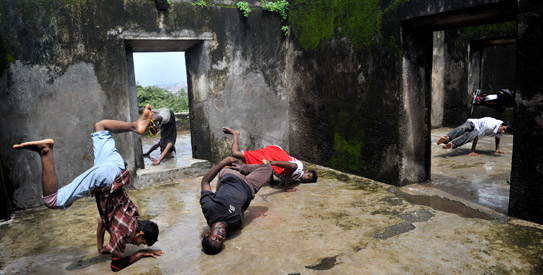
French writer Honoré de Balzac surely did not have Mumbai’s B-Boys in mind when he wrote, “Passion is universal humanity. Without it religion, history, romance and art would be useless.” The B-Boys of Bombay run on passion.
A B-boy (or break-boy) is a male dancer who practices breaking or B-boying, the acrobatic hip-hop dance style. Breaking is a style of dance that evolved among Black and Latino American youth in the Bronx, New York, during the 1970s. It is danced to both hip-hop and other genres of music that are often remixed to prolong the musical breaks.
In Mumbai, it all started two years ago, when 19-year-old Akash, who prefers to be called Aku by his friends, entered the world of dance. “I joined a computer class where they offered to teach us Breaking,” he recalls.
Aku, a resident of Dharavi, is more than just a regular college-going student. He has been B-boying for two years. “Two years ago, HeRa taught us. We didn’t know anything. First we saw videos. I got scared that we would break our hands and legs,” Aku laughs.
“But don’t call it breakdancing,” he adds. The term breakdancing, though commonly used, is sometimes frowned upon by those immersed in hip-hop culture because the term was created by the media to describe what was called breaking or B-boying.
“It took us a week to learn the first step in Breaking. I was wondering how we will learn the dance if it took us a week to learn just the first step,” says Aku, who is a second year commerce in degree college.
Aku’s lessons came from Tiny Drop, an NGO and their crew Slum Gods, a global hip-hop community center. He adds, “Gradually, as the boys practiced, their “pick-up increased”. Now, there’s no looking back. These days, Aku teaches the art to kids who are eager to learn.
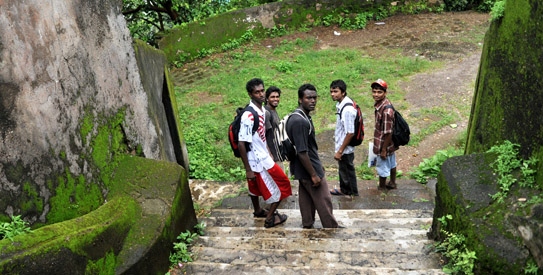
Subu, whose real name is Subhash Naidu (18) is one of them. Subu, also a resident of Dharavi is a beginner. “I got into this through Aku. I was always interested in breaking but there was no support.”
Subu started learning from Aku only two or three months ago. Breaking has pushed studies on the backburner for this lanky teenager.
“I usually bunk classes to practice for two or three hours. I feel like I’m getting better,” he confesses. But Subu wants to pursue Engineering and b-boying.”
Subu’s parents have dreams for him like most Indian parents. His mom works in a government hospital, while his dad has a shop. “They want me to study,” he admits.
Le-yan, who lives in Mankhurd, travels all the way to Sion for practice. He is one of the first B-boys to pick up the art from Slum Gods. The boys get together, even in Mumbai’s punitive monsoon and brush up on their skills. With worn out shoes and ripped socks, the boys start breaking without a care in the world.
But breaking is not all fun. The youngsters have suffered serious injuries that have kept them out of circulation for a while. Mak, another B-boy has a rod in his thumb. Still, he practices three to four hours.
While dancing eight months ago in college, during practice, Mak busted his thumb. “My parents know I am passionate about this. I’ve been doing it for a year now. After I flunked, I dropped out of studies after my first year of college. I want to be the best B-boy in Mumbai.”
The boys don’t lack dedication, but they lack space. As the city has a space constraint, the boys are unable to afford to hire space. “We practice at Sion fort. We’ve cleaned up this space. But the authorities constantly harass us and drive us out of here. We have approached schools and colleges but they don’t want to entertain us,” laments Aku.
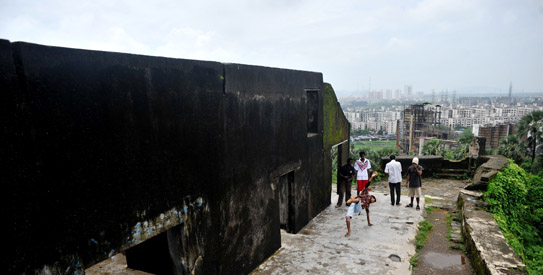
Some of the teenagers are so committed that they even have jobs after college. Mohammed Faisal, better known as B-boy Fuse, is pursuing his second year of studying Commerce. “I work as a salesperson after college and then teach dance too,” says Fuse.
He started free-styling two years ago but knew nothing about B-boying. “For six months I free-styled. Then, I found out about B-boys and started on my own.”
Fuse saw videos on Youtube and learnt from his friends for some months. Then Fuse met friends who were B-boying and got into breaking full time. So far, he has participated in college and local dance academy competitions. But Fuse has dreams, not just passion, “I want to attend battles in other countries too. We can’t afford to go to clubs as there is an entry fee there. We only go when they invite us.”
For the uninitiated
Four basic elements form the foundation of breaking. The first is Toprock, a term referring to the upright dancing and shuffles. The second element is Downrock, which refers to footwork dancing performed on the floor. The third element is the Freeze, the poses that breakers throw into their dance sets to add punctuation to certain beats and end their routines. The fourth element is the Power Moves. These are the most impressive acrobatic moves normally made up of circular motions where the dancer will spin on the floor or in the air.
Dilnaz Boga is an Indian journalist and the recipient of Agence France-Presse Kate Webb Prize for her work in Indian-administered Kashmir.
Pal Pillai is an Indian photojournalist based in Mumbai.


























