0
0


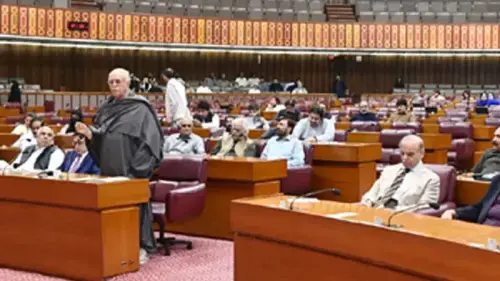
ISLAMABAD, Aug 2: Far away from Karachi’s killing sprees, lawmakers in the National Assembly across party lines on Tuesday called for seeking a political cure to violence in the country’s commercial capital.
The calls came from both sides of the house, with some opposition members demanding that an all-party parliamentary committee probe the latest upsurge of violence in Karachi and Quetta, while a ruling party member suggested taking along all stakeholders, including a breakaway group rival to MQM known as MQM-Haqiqi and the Jamaat-i-Islami, both of which have no presence in the lower house.
The second day of an opposition-sought debate was marked by noisy protests by Muttahida Qaumi Movement lawmakers and a walkout by them to protest against alleged government indifference to the Karachi situation when the house was mid-way through its first private members’ day business that had put off the resumption of the Karachi debate to the third day of the present session on Wednesday.
MQM’s deputy parliamentary leader Haider Abbas Rizvi insisted that the government had promised to resume the debate on Tuesday by skipping the private members’ business, while the chief whip of the ruling Pakistan People’s Party, Khurshid Ahmed Shah, said no such undertaking was given.
MQM members continued shouting and going to an exit and coming back again and again before finally storming out of the house despite assurances from Mr Shah and Speaker Fehmida Mirza that the debate could be held even on the private members’ day, a point to which the Pakistan Muslim League-N, the main opposition party, agreed and did not repeat their Monday’s sympathy walkout with the Karachi-based party.
In a speech after the MQM was persuaded by some members of the treasury benches and the PML-N to end their walkout, Mr Rizvi made a passionate appeal to “save Karachi”, accused unspecified “government people” of involvement in the violence and gave some descriptions of alleged threats to people to leave their homes or see them burned down, factories being attacked and an another MQM MNA, Iqbal Ahmed Khan, surviving four attacks.
But Mr Rizvi seemed short on proposing remedies, except for calling for taking notice of activities of unnamed banned organisations and what he called “mercenaries” of drugs and underworld mafia.
It was former interior minister and PPP-S chief Aftab Ahmed Khan Sherpao who first proposed the formation of a parliamentary committee comprising members from all parties in the house to go Karachi and report back to the house, besides asking the government to provide details of people arrested for violence over the past two to three months and how many were sent for trial.
PPP’s Abdul Qadir Patel from Karachi was greeted with some protest shouts from MQM benches when he described the existence of Mohajir Qaumi Movement-Haqiqi as a “reality” in Karachi because, he said, the number of its members killed was only second to those of the main MQM and suggested the rival group’s involvement in any peace effort as well as of the Jamaat-i-Islami.
But Mr Rizvi’s intervention stopped interruption of Mr Patel’s speech in which the PPP member also traced resort to arms in Karachi in the 1980s and said the city’s police had no capacity to deal with the situation because more than 100 of their officers were “cut into pieces” in the past for trying to do so and nobody was being punished for those killings.
PML-N’s Saad Rafiq seemed endorsing Mr Patel’s views on involving MQM-Haqiqi and supported the proposal for a special parliamentary committee to investigate violence in Karachi and Balochistan before engaging in tirade against the government for alleged misrule and what he called an attempt to divide ethnic “Sindhis and non-Sindhis” in Sindh and warning against the creation of new provinces on ethnic and linguistic grounds that he said could create “several Bangladeshis” in Pakistan. This prompted Prime Minister Yousuf Raza Gilani to rise to say that the PPP leadership had no bias against those who migrated to Pakistan during partition in 1947 and pointed out that his own forefathers had migrated to Multan from Baghdad.