



 3
3


LAHORE: Situated along Queen’s (now Fatima Jinnah) and Waris roads, a 17th century heritage site has now been virtually turned into a solid waste dump, mostly covered with bushes and weeds.
The tank of Lakhpat Rai, known as Paniwala Talaab, was a square masonry measuring around 450 feet in width and length, with a baradari (summer house) to its east.
Lakhpat Rai was a scion of Khatri family of Kalanaur, Gurdaspur district of the Punjab. Rai served as diwan (revenue minister) at Lahore under two successive Mughal viceroys, Zakariya Khan (1726-45) and Yahiya Khan (1745-47) during the reign of Emperor Mohammad Shah. He was again made diwan in Ahmad Shah Durrani's brief government (January 1748) in Lahore, writes historian SM Lateef in his book on Lahore.
The structure, according to Mr Lateef, “is a large tank of masonry. Close to it was the tank of his (Lakhpat Rai’s) brother, Jaspat Rai, but this has been demolished. The tank of the third brother, Narpat Rai, is to the east of Serae Golan Wala, or the Central Jail, but it is out of repair, and is no longer used by the people. The legend runs that, when these three tanks were completed, a certain fakir began to wash his dirty rags in that built by Narpat, whose men did not allow him to clean his tattered dress there.
He then went to Jaspat's tank, with the same object, but his servants, too, prevented him from washing his clothes at that place. The disappointed fakir then went to the third tank of Lakhpat, whose men also objected to the fakir's polluting the water with the dirt of his rags. Lakhpat, who was bathing in the tank at the time, observing this, however, reproved his servants for interfering with the fakir, and permitted him to wash his clothes at the spot.
“Gratified by this treatment, the fakir prophesied that Lakhpat's tank would remain in a flourishing condition for ever, but the other two tanks would dry up,” writes Mr Lateef.
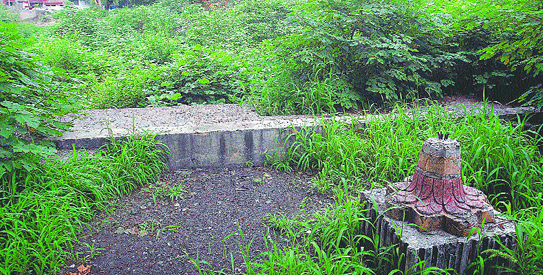
Lahore Conservation Society’s Information Secretary and historian Dr Ajaz Anwar said the prophecy of fakir came true and Lakhpat's tank continued to benefit the people till early 1980s.
“Till the 1960s, the place was called Sukha Talab and it housed an akhara (wrestling ring). The place was taken over by the fisheries department, a tube-well was sunk and a fish pond was developed there. People from the Walled City, Mozang, Ichhra and elsewhere would come here not only to catch fish after paying Re1 licence fee but also for recreation as the tank was surrounded by a well maintained garden besides a ground. Ace cricketer Sarfraz Nawaz and Wasim Akram were among the hundreds of youngsters who used to play there.
“Once Lahore had a heavy monsoon and the pond overflowed, providing the residents of adjoining Bhondpura locality of Mozang an opportunity to catch fish from the Queen’s Road without paying any fee…
“In the early 1980s, commercial activity -- the biggest enemy of heritage everywhere in our part of the globe – began in the vicinity of the tank with setting up of makeshift mechanics shops. Subsequently, electricity supply to the tube-well was disconnected as the fisheries department defaulted on payment of bills. First the tube-well motor was stolen and then its other parts started disappearing one by one and the makeshift shops converting into concrete structures. A portion of the tank was also allotted to a newspaper owner and plans were afoot to develop multi-storey buildings there but the youth of Mozang held protests and managed to save the ground. However, they could neither prevent expansion of shops up to banks of the pond nor could prevent traders from dumping solid waste there,” regretted Dr Anwar. — Text by Zaheer Mahmood Siddiqui and photos by Tariq Mahmood




























