4
4


KARACHI: While the opposition has slammed the PPP-led government over the local government issue, a senior PPP leader has termed the SLGO 2001 violative of the constitution and claimed that its restoration, whether in two districts or all over Sindh, hardly made any difference.
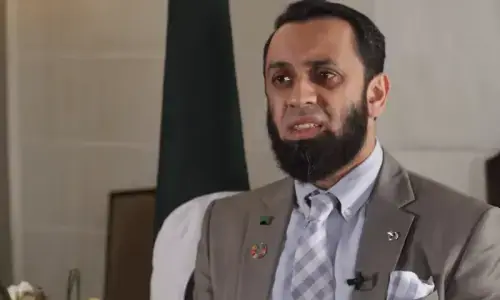
Speaking to this reporter on Tuesday, Secretary-General of the PPP (Sindh) Taj Haider while explaining grounds for his contention said he was surprised that neither he nor the local leadership of the PPP was consulted on the matter.
He said he could not understand that why Khurshid Shah, who had headed the committee to negotiate with the Muttahida Qaumi Movement, was not in the picture when the selective restoration of the SLGO 2001 was announced.
He claimed that the SLGO 2001 ignored the basic criteria of equality of population in districts, clearly demarcated boundaries, homogeneity, contiguity and revenue base. Thus Karachi with a population of 17 million was also a district on a par with Tando Mohammad Khan and Matiari with populations of less than half a million each, he added.
In the days of the dictator, districts were carved out of political expediency, he said. No uniform principles were followed, he added. In almost all cases, the boundaries depended on ethnicity or the ability of a particular mafia to control polling stations at gunpoint. These were prejudices and fault lines, which under the constitution the state is obliged to discourage, he said.
No one could ever explain the legality or the logic behind merging the five districts of Karachi into a single district and at the same time carving out four districts out of the much smaller district of Hyderabad, said Mr Haider.
He said the electoral scheme of the SLGO 2001 allowed 13 members to be elected in a union council on the basis of the 13 highest number of votes by different candidates. The electoral principle of the constitution (except for reserved seats) was that of single member constituencies, he said.
According to him, the population of the union council has to be nearly equal in order to uphold the constitutional principle of equal representation. The size of union councils in Karachi was twice or thrice the size of the union councils in rural Sindh. Keeping a uniform population size of 25,000 persons per union council as in rural Sindh, Karachi would qualify for almost 800 union councils instead of its present 178, he argued.
Mr Haider claimed that union council nazim and naib nazim were elected on the pattern of presidential system of direct vote for the office, violating the constitutional pattern. The district nazim, where the real power rested, was elected on an indirect vote of nazims, naib nazims (elected on the presidential system) and councilors (elected on the multiple-member constituency system), he said.
The constitutional scheme provided for a parliamentary form, which implied that an elected house would be constituted, consisting of members elected from single member constituencies (except for reserved seats) and the member commanding the confidence of majority members would be leader of the house and the chief executive at that particular level of the government, he said, adding that executive and financial powers rested with indirectly elected persons under the SLGO 2001. The irony was that the much-trumpeted devolution stopped at the level of the indirectly elected district nazim, he said, adding that directly elected UC nazim had to remain at the mercy of funds and functions doled out by the district nazim.
Mr Haider said the funds for district governments although distributed among the districts by the provincial finance commission were provided by the federal government.
He said that besides the fact that the local government took all the political credit for schemes financed by the provincial government, the province did not have any control on procedural aspects of the development schemes.
The PPP government carried out prolonged discussions with coalition partners for its replacement with a good law according to our needs and in concurrence with the provisions of our constitution. The need for strengthening the reconciliation process and the imperative of containing violence had once again resulted in our being stuck with this piece of legislation. It was now for the other parties to set political expediency and emotionalism aside and let cool reasoning prevail, Mr Haider concluded.