0
0


BEIRUT: Residents of Hama told of indiscriminate shelling by the army, snipers aiming at civilians and corpses piling up in the streets in the wake of a weeklong military siege of the defiant city.
The government, however, claimed it was ridding the city of ''terrorists.''
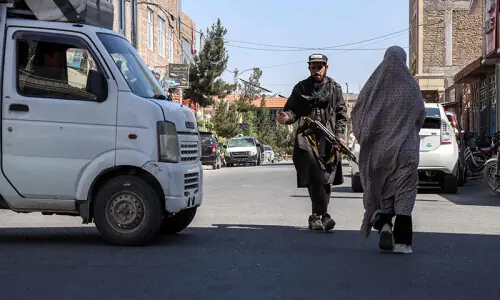
Having blocked nearly all outside witnesses to the violence, President Bashar Assad is stubbornly insisting that terrorists and thugs — not pro-democracy protesters determined to bring him down — are driving the five-month-old uprising.
But the government accounts defy reality, offering a surreal spectacle to the thousands of Syrians facing down the military and to outside observers. Most of the 1,700 people killed since March in the crackdown have been unarmed, peaceful protesters, according to activists and human rights groups.
In a reflection of the difference of opinions, Syria's ambassador to the UN, Bashar Ja'afari, dismissed European criticism of the crackdown and on Wednesday compared to protests in his country to this week's riots in Britain. The remark drew a quick rebuke from a British envoy at the world body, who immediately branded it an ''absurd comparison.''
''We would like to thank the government!'' a Hama resident told The Associated Press by telephone before bursting into laughter. ''What they are saying is pure lies. When they bombed the city, they bombed it randomly. They shot anything that moved in the streets. They were killing people in the streets.'' He asked that his name not be published, fearing retribution from government forces.
The Obama administration, which announced new sanctions Wednesday, is preparing for the first time to explicitly call for Assad to step down, officials have told the AP.
The moves are a direct response to Assad's decision to escalate the crackdown by sending tanks into opposition hotbeds.
The military assaults continued Wednesday. The Local Coordinating Committees, an opposition group that helps organize and document the protests, identified 15 people killed in the central city of Homs, another centre of protests.
The siege of Hama began last week with the start of the month of Ramazan, when the regime feared large prayer gatherings at mosques nightly after the daytime fast would turn into a new wave of anti-government protests.
On Wednesday, Ministry of Information officials escorted journalists on a trip to the city designed to portray the military as Syria's saviour. It offered a rare glimpse inside the city at the heart of the revolt.
''We have finished a delicate operation in which we eradicated terrorists' hideouts,'' an army officer told reporters in the city, some 130 miles north of the capital, Damascus.
Piles of uncollected garbage littered the streets as soldiers removed cement and metal barriers from the streets. About 50 armoured personnel carriers on flatbed trucks headed out of the city, a sign that the military was pulling out after the deadly siege, according to an Associated Press reporter on the trip.
The streets were deserted in the normally bustling city of 800,000 people with a history of defying the regime. In 1982, Assad's father and predecessor, Hafez, levelled the city to crush a Sunni uprising, killing between 10,000 and 25,000 people in one of the darkest moments of the modern Middle East.
The massacre cut to the core of Syria's potentially explosive sectarian divide. The population of 22 million is overwhelmingly Sunni Muslim but they are ruled by members of Assad's minority Alawite sect. The imbalance has bred seething resentments.
''There are no terrorists in Hama,'' another resident told the AP, also asking that his name not be used. ''These claims are just government lies.''
The uprising that broke out in mid-March was inspired by the revolutions sweeping the Arab world. An aggressive new military offensive that began with the Ramazan at the start of the month killed several hundred people in just one week.
International condemnation has been strong and is growing more forceful. On Wednesday, the Obama administration slapped sanctions on Syria's largest commercial bank and cell phone operator as it moved to demand the end of four decades of dictatorship under the Assad family.
The Treasury Department added the state-owned Commercial Bank of Syria and its Lebanon-based subsidiary, the Syrian Lebanese Commercial Bank, to its sanctions list, citing their links to human rights abuses and to illegal weapons trade with North Korea.
Mobile phone company Syriatel was targeted because it is controlled by ''one of the regime's most corrupt insiders,'' said David Cohen, the department's undersecretary for terrorism and financial intelligence.
The action freezes any assets the firms have in US jurisdictions and bans Americans from doing business with them. The sanctions may not have much immediate economic impact because the US already severely limits trade and economic ties with Syria, but they can further hamper the reputation of the companies and lead other governments, such as those in Europe, to enact tougher punishments on individuals and companies close to Assad.
Assad met with envoys from India, Brazil and South Africa on Wednesday and "acknowledged that some mistakes had been made by the security forces in the initial stages of the unrest" and reassured the delegations that reforms were coming, according to a statement from the envoys.
But after a six-hour meeting Tuesday with the Turkish foreign minister, who implored the president to stop the bloodshed, Assad shrugged it off by insisting he will continue to relentlessly fight terrorists in Syria.
On Wednesday, Turkey's Prime Minister Recep Tayyip Erdogan expressed his frustration: "The state is taking aim at its own people with guns and weapons."