



 5
5

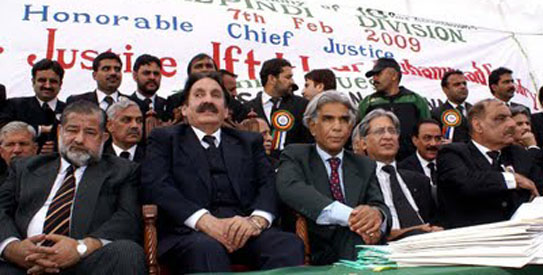
Ones own perspective can often colour their perception of history, especially when it comes to determining the highlights in Pakistan’s history. Due to my own interest in the protection of freedom through a constitutional framework, three periods in Pakistan’s history are especially remarkable. From Muhammad Ali Jinnah, to Zulifqar Ali Bhutto, to the Lawyers Movement, legally-trained leaders helped evolve Pakistan’s constitutional democracy from a dream into a slow-developing reality, and each era learned lessons from its predecessor.
The first stage of Pakistan’s progress through the work of a lawyer started with Muhammad Ali Jinnah, who is regarded as the country’s founding father. Much has been said about Jinnah and the methods or motivations he may have had in creating Pakistan; however, there are some principles he advocated which set the tone for constitutionalism in the country.
First, as a lawyer in India, Jinnah argued a case defending Ilm-ud-Din who murdered a Hindu book-publisher for printing a book defaming the Prophet Muhammad (pbuh). One should compare this to Jinnah’s lifestyle, considering the fact that he was not a traditional practicing Muslim, as well as his advocacy for a secular state in Pakistan. How can one reconcile the act of advocating the case for a man who killed in the name of religion and Jinnah’s own belief in a secular nation that respects its minorities?
One explanation is that Jinnah truly believed in the utility of the court and the respect one must pay to the law, hence he believed Ilm-ud-Din deserved a day in court, just as he believed Pakistan’s Hindus and Sikhs should enjoy the protection of the laws. In fact one of the reasons given for the creation of Pakistan, was that Muslims would face legal discrimination at the hands of their Hindu leaders, and thus, Jinnah focused on formulating a fair legal framework as a central component for the nation.
Jinnah’s words still echo in Pakistan, and his quotes are often used by liberals to argue that because tolerance and legal equality was valued by the founder, that it is an appropriate principle to apply today. However, many have remarked that there was a great disconnect between the Western-oriented Jinnah and the people of Pakistan he was to lead. It is reported that when the famous Urdu poet Allama Iqbal recommended that Jinnah rely more on popular support than on powerful feudals, Jinnah ignored his advice. This again relates to how Jinnah acted more like a lawyer than politician, by forgoing the power of the masses in favor of support from the political and economic “rainmakers”.
The next generation of legally-trained leaders took a lesson from Jinnah’s experience, and focused first on gaining the support of the populace and only then advocating for constitutional and legal reforms. Zulifqar Ali Bhutto, who like Jinnah, had received his law degree in England, helped to bring about the removal of Ayub Khan in the 1960’s. Bhutto rode a wave of massive public support by forgoing his legal formalistic training and acting as a politician. Rather than hold academic discussions on the legal significance of socialist principles, Bhutto captured the hearts and minds of the public with a simple slogan, “Roti, Kapra aur Makan” (Food, Clothes and Shelter).
What is most significant about Bhutto’s rule was that as soon as he came into a position of power, he brought along a cadre of fellow lawyers, like Hafiz Pirzada, with him as advisors. Bhutto’s focus after taking office was the creation of a constitution which could make the rights of people and duties of their government permanent and enforceable.
This focus on legal development eventually helped create the 1973 constitution, which is still in use today and allows citizens to have actionable access to their rights. Though this constitution took years to build, Ziaul Haq made quick work of destroying the document and its significance by adding amendments that destroyed the balance of power and system of checks and balances in government. The dictator was on record as saying “what is a constitution? It is a booklet with twelve or ten pages. I can tear them away and say that tomorrow we shall live under a different system.” This quote embodies the perspective of all military leaders who followed Zia, leading us to the most recent evolution of Pakistan led by lawyers against General Musharraf.
When Musharraf attempted to illegally remove Chief Justice Chaudry from the Supreme Court of the country, he embodied the lack of respect for the constitution that his military forefathers had adopted. However, the lawyers movement struck back by drawing on the lessons learned from their predecessors, Jinnah and Bhutto. By launching several cases against the Musharraf regime in court, the lawyers channeled the judicial formalism of Jinnah. However, it was only by taking to the streets like Bhutto and attracting hundreds of thousands of Pakistanis to stand up for the Judiciary that the movement was able to expel the Musharraf regime.
There is a never-ending list of things happening in Pakistan which give one reason to lament and, indeed, in the legal field itself there has been political wrangling, conduct backdoor deals with the military, and corruption. However, a few generations ago, no Pakistani could imagine the Supreme Court taking action on cases of corruption in the government or leading a commission on the Army-led torture of a journalist. Such progress, transparency, and democratic empowerment could not have been possible without the work of three generations of lawyers in Pakistan who were committed to creating a permanent constitutional democracy.
The writer holds a Juris Doctorate in the US and is a researcher on comparative law and international law issues.

























