0
0

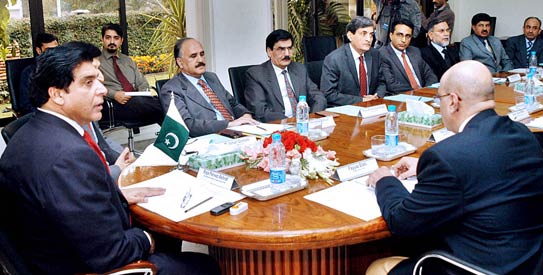
AN attempt was made last week to bring all trade bodies representing various sectors of the textile industry under one umbrella to develop a joint strategy for solving problems impeding the industry’s growth.
“The purpose of this initiative is to collectively protect the interests of the entire textile value chain from cotton growers to apparel makers and influence government’s policies that directly or indirectly affect the textile industry and its viability,” asserts Pakistan Readymade Garments Manufacturers and Exporters Association chairman Ijaz Khokhar, who has initiated the move by hosting a roundtable conference of various sector-specific associations of the industry.
Nevertheless, the meeting remained inconclusive because the participating associations represented divergent views and stakes and their differences on basic trade issues were clear from the very beginning.
Yet the participating associations agreed to form a committee to come up with the minimum common agenda or charter and principles that could be used as the basis of forming the Federation of Pakistan Textile Industry (FPTI) suggested by Mr Khokhar. No timeframe was given for finalising the common agenda or the structure of the proposed FPTI.
This endeavour to forge unity among different sectors of the textile industry will be a success or not is the question. But this exercise is being seen by many as ‘resurgence of the urge in businessmen to influence the country’s economic policymaking process that ultimately affects their investments, profits and viability.’ It, many say, is also indicative of the growing disillusionment of the manufacturing industry with the existing trade bodies— such as the individual chambers of commerce and industry as well as the Federation of Pakistan Chambers of Commerce and Industry, the country’s apex trade body, etc, which have traditionally represented the economic interests of the business community.
Inspired by the corporate India’s growing influence over the country’s politics and economic policy making, Pakistan’s businessmen are looking forward to what a member of the Pakistan Business Council, a body representing the big business, told Dawn “make their presence felt”.
“If the Indian business can decide who should be the prime minister of the country, why can’t corporate Pakistan be made an effective part of the economic policy making?,” he asks.
Majority of businessmen like him appear pretty much disgruntled with the government’s economic policy making process, saying they are not consulted at any level.
“The government must institutionalise the process of consultation with the corporate Pakistan to evolve sound economic policies. Once the businessmen develop a consensus over a policy issue such as new taxation it would not be difficult for the policymakers to implement the decisions,” he says.
The chambers and the federation are often alleged to be run by trading class, “whose interests and demands are in many ways different from the industry.”
In the recent years the office-bearers of the chambers have drawn flak for working for their personal, narrow interests and using their positions to the advantage of their personal business interests rather than the well-being of the whole economy.
“The chambers have lost their utility. They have no influence over economic policy making, their contribution to research and development, skill training and human resource development is minimal,” says S.M.
Tanveer, a manufacturer who has been instrumental in the recent establishment of the Punjab Business Forum to help the industry resolve its problems and issues at the provincial government level.
He says the majority of the existing institutions claiming to be the industry representatives have become ineffective because these are being run very unprofessionally.
“The Federation of Indian Chambers of Commerce and Industry employs 140 PhD professionals who are engaged in research in different sectors of the economy. How many the FPCCI has? None. They don’t consider it their job to do work and carry out research. The R&D sections of chambers are limited to preparing speeches of their office-bearers or scanning newspapers,” he asserts.
His views are echoed by others as well. “The chambers and federation have given up their role of lobbying with government and policymakers for the economy or for the industry and creation of a business-friendly policies and environment in the country. This has created a big void which is now being filled by new organisations like the PBC or the one being created by the textile industry,” says Almas Haider, a leading Lahore-based auto parts manufacturer. “I think the industrialists and traders should have different chambers and government must act as a neutral, fair referee.”
The demand for a separate chamber for the industry is not new. “The chambers of commerce and industry and the federation have completely failed to reconcile the interests of trading class and industrialists,” says a former president of the Lahore Chamber of Commerce and Industry who did not give his name because he did not want to get involved in any controversy.
He says the businessmen remain divided because of their diverging economic interests and problems. “The textile industry has problems and interests different from the engineering industry. The difficulties facing the small industry are very much different from the ones facing the large scale manufacturers. So on and so forth.
Similarly, the traders and industrialists don’t look eye to eye with each other. The industry, for example, wants everyone to pay his share of taxes to reduce the burden on its shoulder. But the traders do not agree and want to stay out of the tax net at all costs,” he argues.
“Now it is the job of the chambers and the FPCCI to reconcile the differing viewpoints and take up a position that is in the interest of the overall economy and people even if it hurts one or more sectors.
However, nobody has ever dared to bridge this gap between the various sectors. Thus, at one level these bodies are seen demanding broadening of the tax net and at another resisting any effort to tax the traders.
It is because the traders outnumber manufacturers with a very big margin in every chamber and in the federation. No one dares to challenge them,” he asserts.
He supports the demand for separate chambers for the industry, traders, small and medium sector enterprises and agriculture “because every sector has different interests, which are sometimes inimical to the interests of the other(s).
“The division of the chambers on the sectoral lines can at a later stage help us evolve some kind of consensus on controversial issues such as taxation, etc,” he argues.