



 0
0

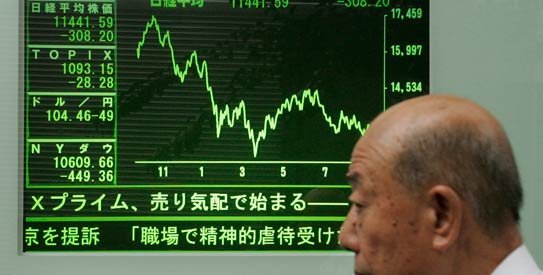
NOTWITHSTANDING the jitters sent across the globe by a possible slide of the US into a double-dip recession and a deepening debt crisis in Europe, officials in Islamabad do not see any unmanageable spillover effect on the national economy.
Perhaps this time around, any setback that they anticipate, would be the making of the existing state of the economy and the country’s governance. Senior economic officials would not comment in public because of implications.
The financial crisis in the US and EU will not have any major impact on the economy because of its limited global integration. Pakistan’s financial markets and banking industry have very minimal international linkages.
"That is the reason we survived the last wave of recession in 2008-2009 as our institutions remained isolated”, said a senior official. Even our portfolio derivatives have no outside linkage, he said.
Theoretically, international trade should be affected by a possible new wave of recession in the US and Europe as more people lose jobs, buying power and living standards. But for Pakistan, this could turn out to be not too much concern. To support this argument, an official said Pakistan will benefit from the falling international prices of commodities it imports, if the double-dip recession does take place.
In times of economic meltdown, the prices of almost all major commodities face a declining trend. Pakistan will be in a position to purchase more quantities at less prices.
For example, oil prices accounting for about one-third ($12 billion plus) of the country’s total imports could fall, not only reducing foreign exchange outflow but also bring down the cost of production for the entire economy.
Same is the case with agriculture - the second largest importer with $6.5 billion a year —could also be a beneficiary, followed by machinery and food group with share of $5 billion each in the import bill.
On the export side, the official explained that Pakistan’s exports normally are affected by economic downturn in the Middle East, European Union, North America and United States. So given the kind of events that are unfolding, a general impression should be that Pakistan would feel the heat but that is not the case in reality.
Practically, Pakistan is exporting on a very lower edge of the commodities which do not come in the category of luxury that the consumer in the West could think of budgeting down. Our exports mainly related to shirts, jeans, towels, bedwear and cotton cloth which are necessities of life and not luxuries, although these items could face price competitions. Even in cutlery, we mostly export kitchen items and not luxurious cutlery items that are used in star hotels.
Similarly, Pakistan was not into high end value added products which could be affected by feared recession like in electronics, cars, vehicles, higher end sports goods, specialised textiles and hospital items which have already started affecting China, EU and Japan. “Neither we export BMWs nor Mercedez, then why should we be worried over economic meltdown and moreover, what worse could you expect than a 2.4 per cent growth rate,” he questioned.
“We are not in the global meltdown bracket anymore. We are in not very dynamic areas that could fall down. We are very slow and in base case areas”. In his opinion, economic meltdowns affected the poor and the common man less than the high end people and with 2.4 per cent economic growth rate, our linkages are already too low to be influenced by outside factors.
He, however, feared that the migration of Pakistanis could be affected as some people have already started to come back. This will slow down outflow of migrants that will have a long-term, unquantifiable loss but in the short-term of one-two years, workers’ remittances could come down that has been one of the few strong points left with Pakistan economy.
But that should not be seen in isolation because remittances have other known factors, too. Explaining, he said, a lot money coming home through remittances was whitening of the black money that people send abroad and bring back as legitimate earnings and save taxes.
In the recent months and years, a number of mafias in Karachi and other cities have developed in the shape of car jackers, Bhatta mafia, land rackets and so on who send money abroad in boxes and bring back through banking channels for whitening and legalising.
Also, a possible deepening of crisis in developed countries could inflict damage to financial inflows because the capacity in the US and EU to lend and donate could come down drastically. And even if they give something to Pakistan for some strategic objective or strategic dialogue, the conditions would be stringent and the quantum negligible.
Already for a $1.5 billion per annum, we have committed two much under the Kerry-Lugar arrangement, the official said. Last year, Pakistan received less than $200 million on that account. And even half of that was spent by foreigners in tribal and other sensitive areas to purchase loyalties of the locals to set up their own networks — both intelligence and political — in the name of development schemes. The cost is too much even if you don’t take into account over-stretching of defence and intelligence capabilities, he explained.
The inflows from multilaterals for specific projects would go on as usual but fresh programmes may be difficult to take off .
However, that has more to do with government performance on economic and governance front than anything to do with global crisis. The bilateral lenders cannot be relied upon for any significant assistance as demonstrated from the outcome of the donors’ and so-called friends of democratic Pakistan conference in Tokyo, Japan about three years ago.
Despite some early jitters in the capital market, the worsening crisis would not have any lasting impact on domestic bourses because our derivatives are very weak and linkages with global capital markets are almost non-existent.
In theory, foreign direct investment should get affected, but it was already on the lowest ebb of $1.8 billion. Whatever investments are coming, they are in the existing sectors — mostly expansion, modernisation and revamping — without any fresh investment for a new industrial project. Perhaps some people could slow down the consolidation process a bit.
On top of that, the public finances could face a set back if a couple of sales transactions led by global launch of OGDCL bonds would not materialise.
But , if the government is able to contain domestic deficit, even such slippages would not matter.
The crux of the overall scene is: There are no more lows to fear about. The challenge is to take a start from a low point but it would depend on the wisdom and priorities of the ruling elite.






























