0
0

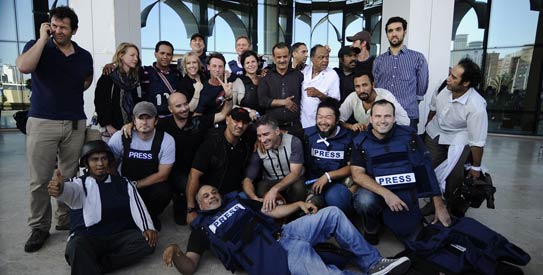
TRIPOLI: They were 33 foreign journalists, a former US congressman and an Indian pacifist held against their will in Tripoli’s Rixos Hotel by armed Qadhafi soldiers, until Wednesday when they were finally freed.
Henry Morton, a freelance journalist working for The Associated Press, says he will never forget his tense 10-day stay at the Rixos and is simply “very happy to be out.” An AFP journalist said that the journalists from several countries, including Jordan, Britain, China and the United States, the Indian and ex-congressman Walter E Faun troy were trapped since Sunday.
The journalists, who were growing short of food and water, left the hotel around 1 pm.
They managed to leave after one of the Arabic-speaking journalists wooed the lone two diehard Qadhafi loyalists who were still standing guard outside the hotel to lay down their weapons and let them leave the premises, Morton said.
Once outside the building, which lies close to Qadhafi’s Bab al-Aziziya compound which was overrun by rebels, the International Committee of the Red Cross helped ferry them to safety to another hotel.
“We have taken 33 journalists and two other foreign nationals from the Rixos Hotel to a safe place,” said Georges Comninos, the head of the ICRC delegation in Libya.
“Our recognised role as a neutral intermediary enabled us to carry out this operation. We are glad that everything went smoothly, but we remain concerned about other civilians and journalists who may find themselves in danger.” In fact, news emerged Wednesday that four Italians journalists were kidnapped by Qadhafi forces and that two French journalists had been wounded.
For the journalists, the nightmare was over after days of being guarded by soldiers armed with Kalashnikov rifles.
On Tuesday the hotel was hit by sniper fire.
For Henry the ordeal started 10 days earlier when rebels attacked the city of Zawiyah, just 40 kilometres from Tripoli, one of the first of three key cities they later seized as they advanced on the capital.
“That is when were all confined to the hotel,” where the Libyan regime obliged foreign media in Tripoli to reside, said Morton.
Hotel staff continued to provide for their clients who were only allowed out to buy their needs from shops across the street.
Saturday the tension rose, Morton recalled, when rebels began swarming into Tripoli.
Fighting flared around the Rixos and the sound of explosions was deafening.
Journalists were kept on the first floor, and spent the entire day wearing bullet-proof vests and helmets. They also hung banners saying: “Press. Don’t shoot.” On Sunday the situation worsened as the rebels moved further into Tripoli.
Hotel staff fled leaving the journalists alone with their armed guards, without water, electricity, television or the Internet. Mobile phone signals were also poor.
“We had no idea of what was going on outside, sitting in the dark,” said Morton.
BBC correspondent Matthew Price told BBC radio: “I got to one point some time on Monday when I thought: they’re going to use this hotel as a barracks for the army for one last stand.
“If they do that, what’s going to happen to us? We found out we had no viable escape route. In the middle of all this violence, with the battle flaring up around us which we could hear but not see, it created this sense of paranoia,” said Price.
Tuesday night, as rebels spread their control over Qadhafi’s compound, located across a wooded area from the hotel, loyalists, mostly young men toting AK-47 assault rifles, stormed the Rixos.
“It was rather frightening,” said Morton.
Several hours later the journalists realised that there were only two armed, and tense, guards outside the hotel.
One of the journalists, an Arabic-speaker, struck up a conversation and managed to convince them to lay down their arms now that the rebels seemed to have controlled large swathes of Tripoli.
Around 1500 GMT the journalists left with the help of the Red Cross to the Corinthia Bab Africa Hotel, in a safer part of the city, they said.
After their release the BBC correspondent said: “We drove out of the hotel compound into a completely different city that the one we had seen seven days earlier.”