0
0

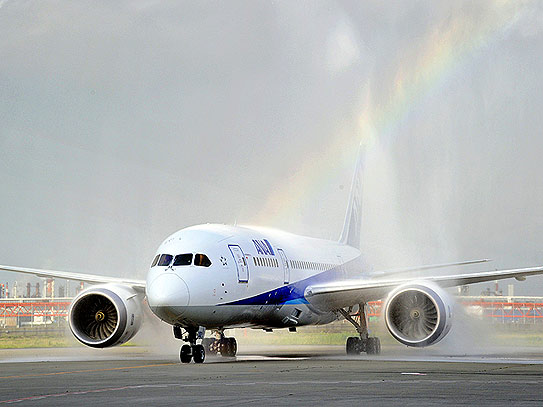
WASHINGTON: Boeing Co was set to conclude a grueling eight-year safety review for its novel 787 Dreamliner after redesigning parts of its ambitious carbon fiber reinforced fuselage.
While much of the focus has been on production delays due to supply chain problems, cost overruns and other setbacks, Federal Aviation Administration and Boeing records detail a long safety review that included an onboard fire that held up test flights last year and six exemptions granted by government safety regulators.
FAA certification of the 787, set to be conveyed at a ceremony on Friday at Everett, Washington, clears the way for deliveries and commercial flights. Japan's All Nippon Airways is the launch customer, which intends to operate it starting in November.
Boeing has logged more than 800 orders for the first mostly composite commercial jet. It expects the 787 and its global supply chain to set the tone for future aircraft models. Boeing also hopes the 787 provides an edge against Europe's Airbus in the widebody market.
With a retail price of $185 million, the Dreamliner is nearly three years behind its original delivery schedule. Test flights concluded nearly two weeks ago.
FAA and Boeing declined to make officials available to discuss 787 certification, safety or outstanding issues ahead of regulatory approval.
Boeing, which like other big manufacturers has heavy influence over certification due to its enormous resources and depth of engineering and technical expertise, said in a statement it complied with FAA requirements.
FAA, in a separate statement, said Boeing's review was longer than typical for a plane of its size, but the 787 proposed a novel design, is heavily comprised of composites and is loaded with new technology.
Unique features that required extra attention from FAA included the carbon fiber reinforced plastic used in construction of the fuselage and wings and advanced electronic systems powering flight controls and the landing gear.
In response to safety questions, Boeing changed elements of the composite design to ensure the fuselage would offer the same level of crash-impact safety as planes made of aluminum.
FAA sets standards for safety but relies on industry to develop and carry out tests. At one point in its review of the 787, FAA declined an outside request to change testing criteria for fuselage crashworthiness.
David Roylance, a materials engineering expert at Massachusetts Institute of Technology, said composites can be tailored and that designers are “getting more and more comfortable” with them. “It's tunable to the stresses and the environment it's going to see,” he said.
Jim Hall, a former chairman of the National Transportation Safety Board, said time will tell whether composites - used at the scale seen on the 787 – will perform as well as metals in commercial aircraft construction.
“The disadvantage is what we don't know,” Hall said. “This is the beginning of a new type of aircraft.” Additional questions centered on the flammability of epoxy adhesives for multilayered composites. Tests showed 787 composites performed well in preventing fire and toxic fumes from penetrating the cabin, the FAA said, noting the Dreamliner complies with all fire-related requirements.
FAA also weighed plans for inflatable lap belts for some seats, a crew rest compartment that sleeps six above the main cabin, and a digital network for a passenger entertainment system and Internet services. There were early FAA concerns that electronics from that network might interfere with cockpit flight controls.
The FAA also approved an updated power distribution system after an in-flight fire last November temporarily grounded the test fleet. FAA personnel were aboard that test flight.
Boeing and Rolls Royce have also satisfied emergency requirements for flying the plane with only one working engine on long-haul routes, a crucial test for ANA. The carrier's first regular long-haul international Dreamliner route will run between Tokyo and Frankfurt.
Boeing received six full or partial exemptions from FAA safety requirements, the latest last week. That involved compliance with a fuel system contamination warning indicator for Trent 1000 engines made by Rolls Royce.
A similar, temporary waiver has been granted for follow-on engines being produced by General Electric Co, documents show.
GE's GEnx engine tests continue. Other exemptions involved certain tests for flight deck seating, lighting criteria at emergency exits, and altitude requirements when catastrophic engine failure causes cabin decompression.
FAA exemptions let manufacturers move ahead with designs while they develop equal or more suitable approaches to specific issues. The FAA mandates inspections or other steps to ensure waivers do not compromise safety.
"The purpose of FAA certification is to make sure manufacturers produce aircraft that are safe for the flying public. But we don't want them to be so regimented that they kill business at the same time," said Snorri Gudmundsson, an aerospace engineering expert at Embry-Riddle Aeronautical University. (Additional reporting by Kyle Peterson in Chicago