0
0

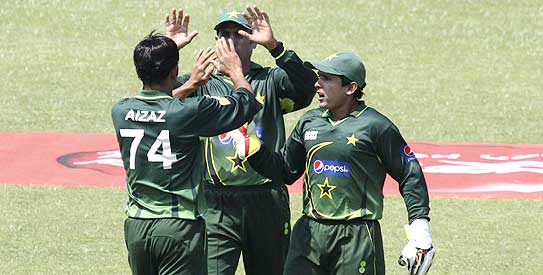
The series against Zimbabwe is not the most exciting thing in the world. It is a kind of no-win situation, because if you win, well you only did what was expected; and if you lose, then God help you.
Still, there are a few key reasons why the ongoing tour to Zimbabwe has been significant for Pakistan.
For starters, we have to be on excellent terms with Zimbabwe because they could well be the first Test side to tour Pakistan when peace returns to our country. They have been in a similar situation themselves, with the major teams shunning them out of political and security concerns. Hopefully, they will have empathy for Pakistan and be willing to break the ice whenever the time comes.
A trip to Zimbabwe also provides opportunity to test young blood. At least this is the stated reason behind Pakistan’s selection policy of taking along new faces such as Aizaz Cheema, Yasir Shah, Sohail Khan, and Rameez Raja. Yet, the PCB has also contradicted itself by including some worn and tired names (Imran Farhat, Taufeeq Umar, and Shoaib Malik), who have not only repeatedly failed but are also too old for long-term prospects.
It is especially perplexing why the likes of Imran Farhat and Shoaib Malik were retained in the team for the second ODI even after they had failed badly in the opening match. The tour management mocked its own philosophy when it preferred Farhat and Malik over players like middle-order batsman Asad Shafiq and opener Rameez Raja, both young and exciting prospects, who are travelling with the team and were available for selection. Hopefully, these and other new names would have been given a chance in the third ODI and the first T20, which will have been played by the time this column appears.
From Zimbabwe’s perspective, Pakistan’s tour is very important because they need to play authentic opposition as they re-enter international cricket after a self-imposed Test hiatus. Political upheavals have prevented Zimbabwe from fulfilling its true cricket potential. They have a racially charged past and a complicated political dynamic since becoming independent from colonial rule in 1980. Yet, they have recorded some notable cricket successes.
Zimbabwe’s first-ever ODI, during the Prudential World Cup played in 1983, made them an overnight sensation when they beat Australia by 13 runs. In the 1992 world cup they managed another famous upset, successfully defending 134 in a round-robin match against England. By now they have over 100 victories in ODIs, although their win-loss ratio of 0.37 is the lowest of all the Test teams, including Bangladesh.
In Test cricket, however, Zimbabwe’s win-loss ratio of 0.18 (nine wins and 50 losses) is markedly better than Bangladesh’s 0.05 (three wins and 60 losses). Over the last two decades, they have managed to draw Test series against established opponents, including India, Pakistan, Sri Lanka, New Zealand and England, and have even recorded two series wins away from home—in Pakistan in 1998 and in Bangladesh in 2001.
Zimbabwe cricket’s latest troubles began in 2004, when their captain Heath Streak was replaced in controversial fashion against a background of simmering political resentments, a move that provoked resignations from several frontline players. This exposed Zimbabwe’s threadbare reserves and proved an embarrassment on the international circuit, with heavy losses triggering a voluntary suspension from Test status.
Recent improvements have given Zimbabwe enough confidence to resume Tests once again. Streak is back in the set-up as bowling coach, and there is a palpable will to move past old grievances. The team enjoyed a bright start against Bangladesh, overpowering them in the only Test by 130 runs, and defeating them in the 5-match ODI series 3-2. But in Pakistan, the team has come across a tough adversary, and it has struggled.
In the only Test, they choked in the second innings on a non-threatening surface, handing Pakistan a comfortable 7-wicket win. And after losing the first ODI in a thriller, they were simply blown away in the second ODI which Pakistan won by 10 wickets—a particularly emphatic result that has happened only 45 times in nearly 3,200 matches played thus far. In fact, Pakistan’s score of 226-0—powered by a flawless hundred from the in-form Muhammad Hafeez—was the second-highest target achieved without losing a wicket in ODI history (just behind the score of 230-0 that Sri Lanka recorded against England earlier this year in the world cup quarter-final).
The end of the tour to Zimbabwe will also bring to a close Waqar Younis’s tenure as the national coach. He took over in March 2010 and has overseen a period of reasonable success for Pakistan, reaching the semi-finals of the T20 and ODI world cups, drawing Test series against Australia, South Africa, and West Indies, and winning a Test and ODI series in New Zealand and Zimbabwe.
Waqar is a bowling legend and did admirable work with Pakistan’s emerging crop of seamers, but he failed miserably at batting improvements. As a result, Pakistan has stagnated at number six in both the Test and ODI rankings, for which Waqar has been criticised. Granted that his tenure coincided with a period of administrative turbulence at the PCB and the country as a whole, but Waqar was also guilty of adding fuel to the fire by quarrelling with senior players. His public spat with Shahid Afridi, in particular, proved most damaging and is bound to leave a stigma on his coaching legacy.
The race is now on for the next Pakistan coach. A search committee is in place and several names, foreign as well as local, are being thrown about. My vote goes to either Rashid Latif or Moin Khan. Each has terrific experience, understands the game deeply, has a teacher’s instinct, and can connect with the boys. You also get the sense that they are truly inspired by national duty. Their qualities and qualifications are not in doubt but, being from Karachi, they will have to overcome PCB’s regional bias which has been repeatedly surfacing in recent times.