0
0

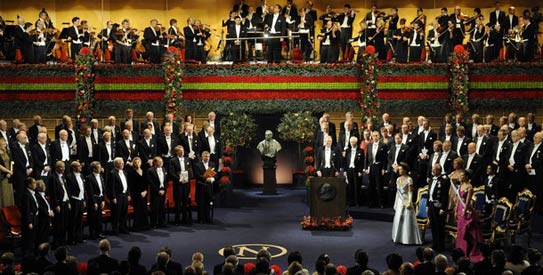
The image shows graceful ceremony of 2008 Nobel Prize distribution ceremony. – AFP Photo
Researchers who developed ground-breaking leukaemia drugs, discovered dendrimers and confirmed Einstein’s view that quantum entanglement is “spooky” are among Thomson Reuters 2011 top tips to win Nobel prizes for science.
The 2011 Nobel winners are due to be announced in early October. Here are some details of the Thomson Reuters forecasts, made using data on how often a researcher’s published papers are used and cited by other scientists.
Physiology or Medicine, to be announced Monday Oct. 3
- Brian Druker Of the Oregon Health & Science University in Portland, Nicholas Lydon, founder of Granite Biopharma, and Charles Sawyers of the Memorial Sloan-Kettering Cancer Center in New York, for their development of imatinib (Novartis’s Glivec) and dasatinib (Bristol-Myers Squibb’s Sprycel) -- revolutionary, targeted treatments for chronic myeloid leukaemia.
- Robert Langer of the Massachusetts Institute of Technology and Joseph Vacanti of Harvard Medical School, for their pioneering research in tissue engineering and regenerative medicine.
- Jacques Miller of the University of Melbourne, for his discovery of the function of the thymus and the identification of T cells and B cells in mammals, along with Robert Coffman, vice president and chief scientific officer of the US-based Dynavax Technologies, and Timothy Mosmann of the University of Rochester Medical Center, for their discovery of two types of T lymphocytes, TH1 and TH2, and their role in regulating host immune response.
- Alain Aspect of the Institut d’Optique, Palaiseau France and the Ecole Polytechnique France, John Clauser, a research physicist at the US-based J.F. Clauser & Associates, and Anton Zeilinger of the Austrian Academy of Sciences, for their tests of Bell’s inequalities and research on quantum entanglement.
- Sajeev John of the University of Toronto and Eli Yablonovitch of the University of California Berkeley, for their invention and development of photonic band gap materials.
- Hideo Ohno, director of the Center for Spintronics Integrated Systems at Tohoku University in Japan for contributions to ferromagnetism in diluted magnetic semiconductors.
- Allen Bard of the University of Texas at Austin, for the development and application of scanning electrochemical microscopy.
- Jean Frechet of the University of California Berkeley, Donald A. Tomalia of Central Michigan University and Fritz Voegtle of the University of Bonn for the invention and development of dendritic polymers.
- Martin Karplus at Harvard University and Louis Pasteur University in Strasbourg, France, for pioneering simulations of the molecular dynamics of biomolecules.