



 1
1

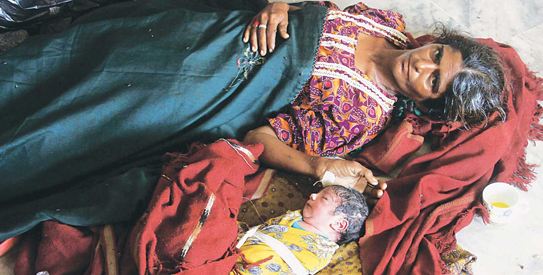
KARACHI, Sept 22: Still recovering from the exhaustion of early morning childbirth, pale-faced Naimat lying with her newborn on the floor of a relief camp in district east of the city takes great pains to narrate what she and her family have been through after the floods hit their small village in Sanghar.
“I have only eaten some biscuits since morning. I am hungry but there is nothing to eat,” the frail woman tells Dawn while Khalid standing close to her and their seventh child says that he needs money to buy his wife some food.
“I am penniless and can’t purchase the food and medicines my wife wants right now,” he says showing a prescription given by a private lady doctor who handled the delivery.
Their grievances were shared by the Hajiani family who also had come from Sanghar after the floods devastated their village.
“I paid Rs2,000 to a private lady doctor running a clinic near the relief camp for the delivery case as there is no lady doctor at the camp. No doctor has examined my daughter-in-law after the birth,” replies Sudhuro, the grandfather, when asked about her post-natal care.
The relief camp set up in a non-functional hospital in the Gadap, off the superhighway, is home to more than 800 flood-hit people, mainly from Sanghar, Tando Allayar, Tando Adam, Shahdadpur and Mitairi. They have been staying here for more than a week.
So far, 313 children, 231 women and 331 men have taken refuge at the non-functional hospital, which currently has the largest concentration of flood victims in Karachi.
A visit to the relief camp shows that the homeless families have found a safe place where they can live till normality returns to their hometowns but food, bedding and medical facilities remain in short supply.
The most vulnerable people among them are pregnant women, young mothers, babies, besides elderly persons and ailing individuals.
“All our valuables were swept away and we could only manage to save our lives and the lives of our children. But our troubles are not yet over as unfortunately we are suffering even at this relief camp,” grumbles a tearful young mother holding a child in her arms.
Babies are not getting milk at the relief camp, she says, explaining that they are too young to consume the food being provided here.
“A majority of women and children at this camp have been suffering from diarrhoea, frequent vomiting and abdominal pains.
The lone doctor at the camp gives us medicines, but they are not making us well,” complains another woman.
Health needs of the flood victims are very serious, with many of them complaining about chronic ailments and almost all children suffering from malnutrition. But no special arrangements seem to have been made by the government to meet the extraordinary situation.
In reply to a question about facilities being provided at the relief camp, a couple of women say that the families get meal twice a day but do not get a breakfast or tea and have to live on the leftovers in the morning. “The first meal is provided at 2pm and the second at 9pm. By that time our children have already gone to sleep without food,” one of them adds.
She also complains about the choked sanitation system.
People who failed to salvage and bring along their bed mattresses while fleeing their homes have to sleep on the floor in the absence of bedding facilities at the camp.
Also the families are in need of new clothes, especially for children, utensils and water containers.
Revenue officials at the camp assert that the temporary accommodation has been arranged only a few days ago and measures are being taken to improve the conditions.
They express ignorance about the childbirth for which the family had to pay Rs2,000 to a private doctor. But they claim that the other pregnancy case was handled with their support and the family did not have to pay for that.
“The children have been vaccinated against polio while tests for hepatitis will be carried out soon. Lady health visitors will also be posted here tomorrow,” says Saleem Baloch, a revenue official, when asked about prenatal and postnatal care of women.
Dr Syed Abid Ali serving at the relief camp was unaware of both delivery cases.
He says the flood victims have been suffering from common infections and so far there has been no outbreak of a disease. “If they are provided with proper food and safe water, many of their health problems will certainly be solved,” he observes.
Ghanwer Khan Leghari, the executive district officer for revenue, says he will personally look into the complaints especially those related to health and will ensure that the situation improves at the earliest.
According to him, the city’s six flood relief camps set up in Gulshan-i-Hadeed, Gadap, Manghopir, Gulshan-i-Maymar and Khokarapar are playing host to more than 1,800 flood victims. “Besides many families, who are not registered with the government, are staying at their relatives’ place in different parts of the city,” he adds.



























