



 0
0

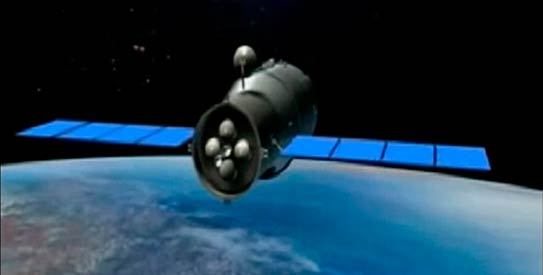
BEIJING: China is due to take its first step towards building a space station on Thursday when it launches an experimental module ahead of the country’s National Day celebrations.
The Asian nation sees its ambitious space programme as a symbol of its global stature, growing technical expertise, and the Communist Party’s success in turning around the fortunes of the formerly poverty-stricken nation.
Space authorities say Tiangong-1, or “Heavenly Palace”, is expected to take off between 1316 and 1331 GMT from the Gobi desert in China’s northwest, propelled by a Long March 2F rocket, ahead of National Day on October 1.
The unmanned 8.5-tonne module will test various space operations as a preliminary step towards building a space station by 2020.
As part of this, Tiangong-1 – which has a two-year lifespan in space – will receive the unmanned Shenzhou VIII spacecraft later this year in what would be the first Chinese docking in space.
If this succeeds, the module will then dock with two other spacecraft -- Shenzhou IX and X -- in 2012, both of which will have at least one astronaut on board.
The technology for docking in space is hard to master because the two vessels, placed in the same orbit and revolving around earth at some 28,000 km/h (17,360 mph), must come together progressively to avoid destroying each other.
For Tiangong-1, “over 170 technical modifications had to be made to the rocket launcher”, Cui Jijun, director of the Jiuquan launch centre in Gansu province, told the official Xinhua news agency.
Alterations were also made to the launch base -- where the computer centre is located -- in order to be better prepared for any unexpected developments during the mission, Cui added.
China, which has only been open to the world for some 30 years, is playing catch-up in the space arena.
Just like its first manned spaceflight in 2003, the planned space docking later this year will emulate what the Americans and Russians achieved in the 1960s.
“The Chinese are using identical docking systems to the Russian ones because the Shenzhou programme was originally inherited from Soyuz technologies”, French researcher Isabelle Sourbes-Verger told AFP.
The Soyuz spacecraft were initially conceived by the Soviet Union in the 1960s, and are still in service.
China aims to finish its space station, where astronauts can live autonomously for several months like on the International Space Station (ISS) or the former Russian Mir, by 2020. But before it does that, it will likely complete other test launches after Tiangong-1 returns in 2013.
“If the Chinese can show that they have a correctly functioning docking system then this will put them in a potential position to one day access the ISS”, said Sourbes-Verger, a specialist in China’s space programme.
But she cautioned that this was not likely to happen in the next five years. Morris Jones, an Australian space analyst, said the biggest obstacles to China’s entry to the ISS would be political.

























