0
0

EVERYTIME there is a change at the helm of the Pakistan Cricket Board (PCB), there is renewed hope of betterment in the country’s top sport organisation.
The nomination of industrialist/politician Chaudhry Zaka Ashraf as the successor to the embattled Ijaz Butt, whose rather calamitous three-year reign as the chairman ended on Oct 8, has literally come out of the blue and has taken the cricket fraternity in the country by surprise.
Being a close friend of President Asif Ali Zardari, who is also the PCB patron-in-chief, obviously played a significant role in Zaka Ashraf landing the most sought after post in Pakistan sports, given the fact that the incoming chairman has never played the game himself, at least not at the higher level.
Moreover, it remains to be seen whether the new PCB boss retains his status as the current president-cum-chief executive officer of the Zarai Taraqiati Bank Limited (ZTBL) as well as key member of the ruling party’s executive committee.
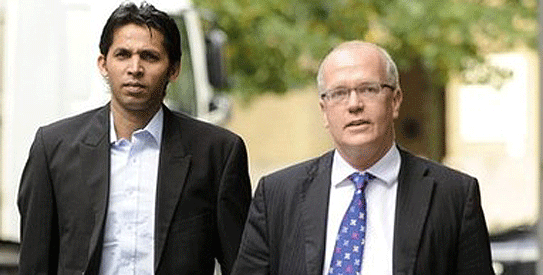
Shortly after being nominated, Ashraf briefly outlined his plans on how he will run the affairs of the board which faced one crisis after another in the Ijaz Butt era. The two serious challenges that Ashraf will have to tackle at the start of his rule include the ongoing spot-fixing trial in a London court against tainted players Salman Butt and Mohammad Asif and the revival of international cricket in Pakistan.
Also, coming from a political background could, ironically, prove a blessing in disguise for Ashraf rather than a dilemma given the intriguing politics of the PCB. The much cursed ad hoc system on which the PCB had been functioning since July 17, 1999 is one issue that all subsequent chairmen since the respectable Khalid Mahmood’s tenure have failed to resolve.
The new PCB chief can’t afford to overlook this glaring shortcoming any longer because the game’s governing body — the International Cricket Council — wants Pakistan to run its cricket in a democratic and transparent manner.
This would be only possible if the general council is revived in the cricket board and give all its affiliated units — associations and departments — their overdue status under the 1994 constitution of the board besides bringing a culture of accountability.
Under the ad hoc rule, the respective PCB chairmen enjoyed extraordinary powers and behaved like a dictator. Of course, not all of them were like that. Tauqir Zia, then a serving Army general with a great cricketing vision, demonstrated his love for the game by developing grounds in remote parts of the country besides building academies for the budding cricketers.
Former ambassador Shaharyar Mohammad Khan used his diplomatic skills to the hilt to revive cricketing ties with India.
During his tenure, the South Asian arch-rivals undertook three bilateral tours, including the historic groundbreaking series in the spring of 2004 that took place in Pakistan.
Dr Nasim Ashraf succeeded Shaharyar after serving some time on the board’s governing body, but chose to quit after 22 months following the end of General Pervez Musharraf regime in August 2008.
First-hand information about Ashraf shows that he is media shy and doesn’t open up easily. But on matters relating to cricket, he has to decide what sort of approach he’ll adopt because his immediate predecessor behaved rudely with the media personnel whenever hard-hitting questions were posed to him.
The success — or failure — of Ashraf will inevitably depend on the team he heads. There are several names making the rounds as to who’ll be the next chief operating officer. And then the choice of head coach for the national side, and probably a new selection committee are other key decisions he will have to take.
But the most important thing for the chairman to decide will be his level of interference in the cricketing matters, considering the fact that his own knowledge about them is almost negligible.