0
0


ISLAMABAD: The United Nations Office for the Coordination of Humanitarian Affairs (Ocha) has said that assistance to more than 8.9 million people affected by floods in Sindh and Balochistan may come to a halt in November after depletion of relief supplies by the end of the current month.
Only 18 per cent of the funding requirements have been received so far, $64.5 million of the $357 million requested in the Rapid Response Plan launched last month, Ocha said in its latest situation report on Saturday.
Access to the affected areas is improving as the water is receding. However, relief efforts remain hampered by funding constraints.
Given the current funding, water, sanitation and hygiene supplies may only be available for just under a month.
Emergency shelter supplies have been estimated to last three weeks and food stocks will be available until the end of October.
If more funding is not received there will be serious shortfalls after the current month.
A rapid protection assessment has identified several issues, including restricted access to available assistance for vulnerable groups, lack of female-friendly space, violence against women and the presence of unaccompanied children.
The assessment revealed that three million people were in need of immediate food assistance in Sindh and Balochistan with reports of high level of child malnutrition.
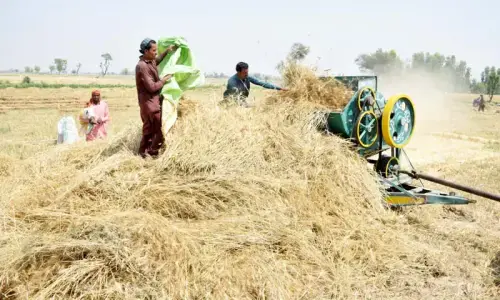
Ocha says that support for the upcoming Rabi planting season commencing next month is critical to ensure both food security and livelihoods recovery. This would require funding for both seeds and on-farm rehabilitation work to be undertaken by the Food and Agriculture Organisation (FAO) and World Food Programme (WFP). Damage to the irrigation system was of additional concern.
The FAO was reaching nearly 20,000 households comprising about 140,000 people. In the coming days, it will distribute emergency animal fodder and hundreds of thousands of deworming tablets in Benazirabad and Mirpurkhas districts.
Due to depleting stocks, the government is also scaling down its assistance leading the humanitarian agencies to increase their activities in the face of the funding shortage.
Ocha points out an urgent need of immunisation campaigns, child health coverage, strengthening of essential services, and water and sanitation facilities.
It said that more than 96 per cent of the 294 water sources tested by WHO teams in Sindh's affected districts were found to be contaminated and creating a major public health risk.
The report said that health response needs were to be strengthened in Sanghar, Tharparkar and Umerkot.
Access to safe drinking water and sanitation facilities remains a critical issue.
The unavailability of female hygiene kits, undergarments, emergency lights and separate toilets and bathing facilities for women and girls has been identified as exacerbating their vulnerability.
Ocha points out that there is only limited information about needs in Balochistan. Access to flooded areas in the province and lack of accurate information on needs and response from institutions outside the system remains a main challenge.