



 0
0

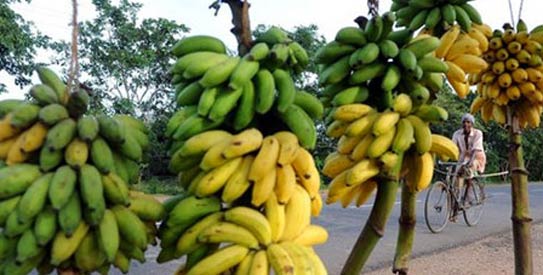
CAIRO: Using old banana trees to make compost may help boost crop yields while cutting down water and fertiliser use, according to an Egyptian researcher.
Banana-based fertiliser could cut about 20 per cent of the water used in irrigating maize and lead to better yields and improved soil properties — such as availability of micronutrients and soil moisture — a researcher at Egypt’s National Research Centre has found.
Banana trees — in fact a large herb — only fruit once and most of the farmers in Egypt, who plant more than 52,000 acres of bananas, burn the trees (stems) after they have borne fruit, even though they are hard to burn because of their high moisture content.
Now, Nesreen H. Abou-Baker, who was awarded a PhD last month for her research, says these trees could be put to better use.
She mixed banana residue with manure and microorganisms, such as yeast, and tested the compost in field experiments at the Noubariya Agricultural Research Station, north of Cairo, during four successive growing seasons of corn and beans.
“Using banana compost we get greater efficiency of nutrients in soil compared with other fertilisers, good aeration associated with the relatively low application of irrigation water, and decreased nutrient losses by leaching,” said Abou-Baker.
The concentration of heavy metals — cadmium, lead, nickel — in the plants was also reduced when grown with banana compost instead of conventional mineral fertilisers.
The compost may be of use in other banana growing areas, outside Egypt, Abou-Baker said. It could either be prepared by farmers themselves or commercially produced and sold to farmers.
Salah Saad Zarad, associate professor at the agriculture division of the National Research Centre, said: “Mineral fertilisers are too costly to be used in large quantities for profitable production in developing countries so crop residues are a promising alternative for nutrient recycling in soil … easily and cheaply available on a farm”.
Zarad said the findings are encouraging, and suggested it may be more cost-effective to set up commercial production of compost, instead of banana farmers producing it individually.
Ahmad Gamal El-Dein Wahba, vice president for research at the Agricultural Extension & Rural Development Research Institute, said: “This finding could make farmers better appreciate banana compost”. He added that even banana trees infected with bunchy top virus, which have to be destroyed, could now be utilised. -- www.scidev.net


























