5
5

KARACHI: “Each story is more heart-rending than the next,” says S.M. Ilyas, a physical therapist heading the Paraplegic Centre, in Hayatabad, in Peshawar. “A lot of the permanently paralysed are young and the sole bread-winners,” he says, referring to survivors of spinal cord injuries (SCI).
SCI is usually caused by an accident, road accident being the most common one, and depending on where the vertebrae and nerves are damaged, the symptoms of the injury can, according to Ilyas, virtually make the person a “prisoner of his/her own body and him/her losing control over his/her bowl and bladder”.
“Your spine not only keeps your body upright, it protects the delicate nervous tissue called the spinal cord that serves as a link between your body and the brain,” he tells Dawn.com
Terming it a “medical emergency”, Dr Farooq Rathore says: “Adequate evacuation, good pre-hospital care and immediate medical care” can reduce the rate of complications and improve the long term outcomes.
Rathore, a consultant in Rehabilitation Medicine at Department of Rehab Medicine, in CMH Panoaqil, in Sindh, has carried out extensive research and widely been published.
The centre, set up in 1983 by the International Committee of the Red Crescent after the Soviet war in Afghanistan, provides free of cost services to over 350 survivors of SCI annually, although it costs an estimated Rs. 50,000 for the complete rehabilitation of each individual which can take anywhere from three to six months. It also serves as a model for developing countries using local technology and equipment. It gets funds from both the government and donors across the globe.
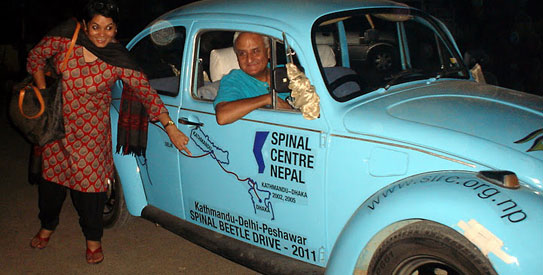
It is the place where Kanak Mani Dixit, 56, a Nepalese journalist and rights activist, and his wife Shanta, will end their beetle journey.
The duo are on a mission – to raise funds for a Spinal Injury Rehabilitation Centre, in Nepal and spread awareness about spinal injuries in their 1972 blue Volks Wagon.
They aim to raise US $110,000. “The total driving distance from Kathmandu to Nepal is 1,100 miles, so we hope to collect US$100 per mile from friends and supporters from all over the world.” says Dixit. “And if we cannot collect the money, we will stay where the amount runs out, and get old there together, that is what my wife tells me!” he adds mischievously. This will be their third road fund-raising trip; for the previous two (in 2002 and 2005) they had headed to Dhaka. In the first four days of their journey, they were able to collect US $26,000.
In 2001, Kanak, trekking in the foothills of Mount Annapurna (the tenth highest peak in the world, also amongst the three most dangerous) missed a step and fell 150ft down. After four days of living on a jutting rock and dealing with severe vertebral injuries, he was rescued. He had broken three vertebral discs of his neck and had to undergo a nine-hour surgery, and wear an external fixation for three months.
From Kathmandu, the Nepalese couple reached Delhi, then Lucknow and Amritsar. After entering Lahore from Wagah on Nov 11, they will go to Lahore, Rawalpindi and end the journey in Peshawar’s paraplegic centre.
Dixit’s beetle journey reminds one of a journey carried out in 2004 by Sarmad Tariq, who holds the world record for the longest non-stop drive by a quadriplegic, in a hand-controlled car for 33 hours. Covering a distance of 1,847 km from Khyber to Karachi, he says: “It was more a personal challenge to raise awareness that those whose independence is limited have enormous untapped potential,” says the 36-year-old story teller/motivational speaker. After meeting a swimming accident at the age of 15, Tariq was left shoulder down paralysed and confined to a wheelchair.
The general level of awareness about SCI, “its magnitude and its role in causing a long term, often irreversible disability”, points out Rathore, is low not only among the general population but even health care providers in Pakistan.
In the 2005 earthquake that struck northern Pakistan, he says, an estimated 650 to 750 suffered SCI.
In the absence of a national SCI registry, he says, it is difficult to give an accurate assessment of the number of individuals who suffer from SCI in Pakistan every year. However, based on research articles published over the last one decade, Rathore estimates the number to be anywhere from 1,000 to 1,500 every year.
In Pakistan SCI is initially managed by neuro-surgeons, spinal surgeons and in some cases even by orthopedic surgeons in general surgical wards. But dedicated spinal rehabilitation units (that provide a comprehensive continuum of care for the SCI starting from initial care, nursing care, surgical management, comprehensive rehabilitation and ending into vocational or community based rehab) is conspicuously missing.
Ilyas admits to seeing an increased number of SCI among people caused by suicide attacks, bomb blasts, landmines, improvised explosive devices, but what he finds particularly tragic is the survivors of accidents caused due to negligence and which are completely preventable – falling from electric poles, under construction buildings, open manholes – because “safety rules” are not in place or implemented.
But among all these, it is the “reckless and culturally acceptable celebratory shooting of a firearm in the air” that Ilyas finds the most tragic.
“An occasion as happy as the birth of a son, or a wedding in a family” he points out, “when a father on hearing the good news, cannot hold back his emotions, and sprays a round of bullets in the air,” he says turns into another family’s tragedy.
Farzand Ali, 12, is among three of the 62 survivors of SCI who was admitted to the centre this year, after he became a fresh victim of aerial firing.
In March, this year, Ali, belonging to Sher Ghund village in Swabi district, was playing in the compound of his house when an errant bullet hit him and on his neck.
His father Liaquat Ali, a daily wage-earner, has no clue how a bullet could have hit his son, but is resigned to the fate. He is happy the progress made by his son, who till six months back was completely bed-ridden. “From calipers on his feet, he has progressed to using just elbow crutches and has re-joined school too,” he points out.
The centre, the only one of its kind for the civilian population provides free, comprehensive post-operation rehabilitation.
There is another one in Rawalpindi, the Pakistan’s Armed Forces Institute of Rehabilitation Medicine which caters for the armed forces personnel and their dependents. While civilians can also avail the rehabilitation, they have to pay for the services.
“People come to us from as far off places as Karachi with complications after their surgery,” says Ilyas.
While the centre does not carry out spinal surgeries, he says post-operative care provided is par excellence.
There is another reason for the Dixits to take on this South Asian ride in their blue beetle. Much of it is along Sher Shah Suri’s Grand Trunk Road listening to Pathany Khan, Kumar Gandharva, Beetles, Simon and Garfunkle and old Hindi filmi numbers - they want to show to others that the trip is fun and “doable” across these three South Asian countries.
“The weather is good, and we did 80 km per hour on the plains of Nepal,” said Dixit. With a good navigator in Shanta, he thinks the journey will provide “good bonding time” with her as they are busy otherwise in Kathmandu.
Meanwhile, Ilyas is all set with a full-fledged plan for the Dixits. “I want to introduce them to some of our star patients,” he says excitedly.