0
0

WASHINGTON: The US State Department stressed the need to continue the democratic process in Pakistan as Ambassador Husain Haqqani headed home to appear before a parliamentary committee to try and put a lid on the ‘memogate’ scandal.
“We clearly support the democratically elected government of Pakistan, as well as its constitutional processes,” State Department spokesman Mark Toner told a briefing in Washington.
But the White House and the Pentagon underlined their links with both civilian and military establishments in Pakistan while refusing to take sides in a crisis that threatens to undo the current democratic set-up.
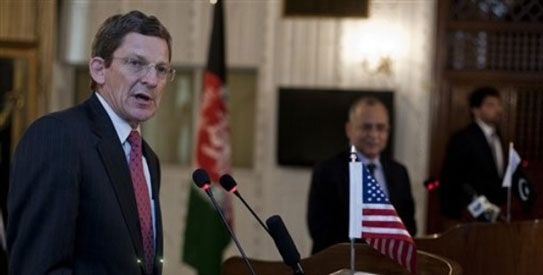
As the storm over an alleged presidential memo to seek US support for reining in the army gathered storm, America’s special envoy for Pakistan and Afghanistan Marc Grossman met Ambassador Haqqani hours before he boarded a plane for Islamabad.
After the 35-minute meeting, the State Department issued a statement, saying that Ambassador Grossman had never seen the memo before it was made public.
During the meeting, Mr Grossman “referenced the statement of Admiral Mike Mullen’s spokesperson that Admiral Mullen did receive a letter from Mansoor Ijaz but that ‘he did not find it at all credible and took no note of it then or later’. Therefore, he addressed it with no one,” the statement said.
Mr Ijaz, a Pakistani-American businessman, claimed in a newspaper article last month that he delivered an alleged memo from President Zardari to the-then US military chief Admiral Mike Mullen, seeking his support for sacking several senior Pakistani military officials for averting a possible coup.
Mr Ijaz claimed that Ambassador Haqqani dictated to him the contents of the memo. Mr Haqqani has rejected the claim as “a bundle of lies” and on Friday night he boarded a plane at Washington’s Dulles Airport for home.
The ambassador told Dawn that he would appear before a parliamentary committee in Islamabad, which would be headed by a religious scholar who was also a member of parliament. He said the committee would hold a full inquiry into the so-called ‘memogate’ scandal and would try to “sift facts from fiction”.
Mr Haqqani said he would also urge the committee to investigate why “the statement of a doubtful individual was blown out of proportion”. The ambassador said the enemies of democracy were behind the scandal and they wanted to “use it as an excuse to undo democracy”.
As Mr Haqqani left for home, the issue was raised at all three bastions of power in Washington, the White House, Pentagon and the State Department.
“We have obviously a critically important relationship with Pakistan. We have a critically important counter-terrorism relationship with the Pakistanis that we work on every single day,” said National Security Adviser Tom Donilon when asked if the White House was aware of the issue.
“We have, obviously, the support that we need for our efforts in Afghanistan that we work on each day with the Pakistanis. We work with both the civilian government and with the military, depending on the issue,” said the White House official, refusing to take sides on this dispute. “I don’t have a way, from this distance, to comment on the question that you raise,” said Mr Donilon when asked if he believed the scandal could unseat Mr Zardari.
At the Pentagon, Press Secretary George Little told reporters that US Defence Secretary Leon Panetta was aware of the issues related to the memo. However, he said that “no review” had been ordered when asked why serious allegations in the memo were ignored by the office of the chairman of the joint chiefs of staff.
“But don’t think we do not take such matters seriously,” he added.
Mr Little said the Pentagon stood by Mr Mullen’s spokesman Capt John Kirby who initially denied but later confirmed that the admiral had received the memo but took no action.
At the State Department, spokesman Toner told reporters that he was not going to engage in speculation about the possible consequences of the ‘memogate’ scandal.
“Our understanding is that he’s still the ambassador of Pakistan to the United States, and we continue to have regular interactions with him, as we do with a number of people,” said Mr Toner when asked what was the State Department’s position on Mr Haqqani’s status.
At the Pakistan Embassy, Mr Haqqani’s well-wishers were in tears as he waved them goodbye before heading to the airport.
Many thought this could be his last trip to Pakistan as ambassador.
But not Mr Haqqani, who said he was confident that he would be exonerated and would return “with a clean slate”.
Minutes before his flight took off, the ambassador tweeted to his friends: “On way to motherland, Pakistan.”