0
0


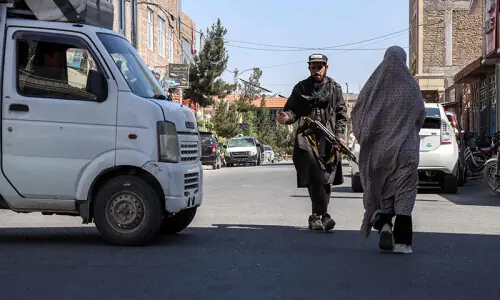
CHARIKAR: Foreign troops began the second stage of a security handover that aims to put Afghans in charge of the whole country by the end of 2014 with a ceremony on Thursday in a small town on the plains north of Kabul.
This new phase of a years-long transfer programme will extend Afghan security coverage to half the population, and move beyond the largely showpiece areas chosen for the first stage.
Being able to say 50 per cent of Afghans rely on their own police and army for security is a key milestone for the government's Western backers, who will attend a major conference on Afghanistan's future in Germany next week.
With an economic crisis gripping Europe, smaller budgets in the US and electorates weary of a decade-long war, politicians are keen to show progress in leaving Afghanistan -- without letting the country descend into civil war.
All foreign combat troops will leave Afghanistan by the end of 2014, with the rapidly expanding Afghan police and army assuming full security responsibility in their place.
At a handover event in Charikar in Parwan province, little over an hour's drive from the capital Kabul, US troops ceremonially folded the American flag before passing control to their darker-uniformed Afghan counterparts.
“We have been monitoring areas in the first tranche (of transition) and note that violence has decreased, and in some areas has decreased significantly,” said the commander of the Nato-led International Security Assistance Force (ISAF) and US troops in Afghanistan, General John Allen.
He was speaking in the grounds of the Parwan provincial governor's bombed-out compound, where a suicide attack in August killed a dozen people. All but two districts of Parwan will be handed over in this tranche.
Entire provinces where the handover formally begins this week are Balkh, Takhar and Samangan in the north, central province Daikondi, Nimroz in the south, and Kabul.
Districts within Helmand, Herat, Ghazni and other provinces will also be passed into Afghan control, ISAF said.
“For these areas and all the others in the second tranche, we will see the patchwork become whole ... as pieces of Afghanistan are knitted together again by Afghan hands,” Allen said.
On Dec. 5, representatives of 85 countries will meet in the former German capital of Bonn to discuss Afghanistan's future.
Not present, however, will be Pakistan, neighbour of Afghanistan and key to regional stability, which pulled out in response to a Nato cross-border attack that killed 24 Pakistani soldiers.
US Secretary of State Hillary Clinton said on Wednesday Pakistan's decision to boycott the conference was “regrettable”, but she hoped to secure Islamabad's cooperation in the future.
The US Senate voted on Wednesday to require President Barack Obama to devise a plan for accelerating the pullout of US troops from Afghanistan, signalling growing impatience in Congress with American involvement.
“Transition does not mean the international community is walking away from Afghanistan,” US ambassador to Afghanistan Ryan Crocker said at the event in Parwan.
Despite the presence of tens of thousands of Western forces in Afghanistan, the United Nations and other groups say violence is at its worst since US-led Afghan forces toppled the Taliban from power in late 2001.
Nato-led forces say they have seen a decline over recent months in attacks launched by insurgents against their troops.