0
0

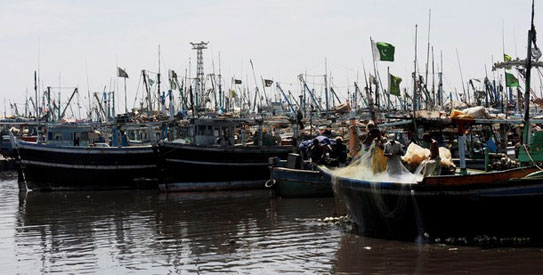
THATTA: Fishing communities in coastal areas of the district have turned to hunting crabs as an alternative source of livelihood because of depletion in fish resources caused by deep-sea fishing by trawlers and their use of large, illegal nets.
The Indus delta, the fifth largest delta system in the world and once with to an extensive network of creeks, marshes, mudflats, swamps and mangrove forests has fallen prey to over-fishing and neglect.As the winter sets in, small vendors, retailers and wholesale dealers set up shops in the coastal towns of Jati, Chuhar Jamali, Keti Bandar, Ghorabari, Gharo and Mirpur Sakro to buy crabs and sell them to exporters.
Sikandar Thaheem, 56, a fisherman of Jati, told this correspondent that in the past fishermen used to throw back into the sea some species of fish and crabs because there was no demand for them in the local market.
But now the situation has changed and crabs are being exported to Southeast Asian countries. Around 5,000 fishing families from various creeks of Thatta, he said, were now hunting crabs.
Crabs are generally categorised by their weight and colour. The immature and blackish brown crabs are categorised by weight - 120 gm, 150 gm and 300 gm. But the mature crabs are orange, yellow, blue and green.
Haji Yousuf Katiyar, a seasoned fisherman of Kharochhan, said the delta eco-region has become dirty, dry and saline as it receives less freshwater or no water at all. Limited inflow of water into the deltaic area is responsible for the depletion of fish along the coast by as much as 50 per cent between 1993 and 1999.
This, he said, had forced hundreds of people to shift to other areas and many others have adopted alternative work.
Decline in Indus water flow has resulted in severe depletion of prized species of fish like Pallo, Mangar, Dangri, Paplet, Thairi, Popri, Danbhro, Morakho, Kuriro, Singari, Mundhi, Dangrio, Sario, Gandan, Gangat, Loohar and Khago. Pallo used to account for 70 per cent of the total catch in the past but now it barely constitutes 15 per cent.
Jalal Solangi, a crab exporter, said that an estimated 10 to 15 tons of crabs were exported daily from Sindh coast. The quantity increases to 18 tons a day with the increase in catch due to high tide.
The Sakro-Badin coastal belt, he said, had more than 400 crab farms and there had been an increase in catch over the past decade. But with more people turning to crab hunting the situation as changed.
However, he said, the rise in price in international market had increased the export value. Price of a kilo of crabs ranges between $5 and $20.
“Major markets for Pakistani crabs are China, Indonesia, Thailand, Singapore and Hong Kong. “More than 95 per cent of it goes to China,” said Jalal.
“Dealers export live crabs on a daily basis through cargo flights. The perishable commodity has a brief life span but since the local crab has less flesh it has a longer life span than species found in other parts of the world,” he said.
Mangroves provide an important habitat for fish and invertebrates and serve as important spawning grounds and nurseries for fish and aquatic crustaceans.