0
0

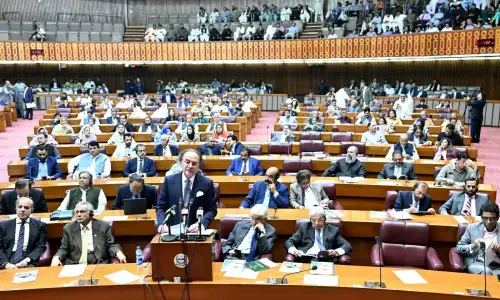
BY wading into the memogate scandal in a controversial manner, the Supreme Court has raised more than a few questions about the separation of powers, the supremacy of parliament and the law itself. Consider. A government whose ambassador to the US was dragged into scandal has returned to Pakistan, resigned from office and pledged to submit himself before a parliamentary inquiry that the prime minister himself has vowed will be carried out. That the matter, involving a memo delivered to the office of the then US chairman of the joint chiefs of staff, is to be brought before parliament and not a handpicked investigation commission favourably disposed towards the government is highly relevant here. Thus far, the government does not appear to have taken any steps to shield one of its own from parliament or the court of public opinion. With the parliamentary wheels already in motion, what was the need for a parallel inquiry to be concluded 'within three weeks' by a special investigator appointed by the SC? Would not the result of this inquiry, almost certain to be completed before parliament's own probe, influence the minds of the members of the parliamentary commission?
There are more questions here. In ordering the inquiry, whatever the narrow legal point at stake, the court has lent credence to the theory that the memo, had it in fact been drafted at the behest of someone in the government, was ostensibly a criminal or illegal act that needs to be investigated. Is this necessarily so? However ill-advised the memo may have been, a close scrutiny of the six points it contains does not reveal any decisive 'treasonous' material. The president is the constitutional supreme commander of the armed forces and the prime minister is the constitutional chief executive. In a court of law, all that should matter is whether they have the authority to take certain measures.Moreover, given that no action whatsoever was taken on the basis of the memo — even the harshest critics of the government have not alleged this — a peculiar situation arises that an inquiry has been mandated by the SC to examine events that could have happened but in fact never did happen. Should such political conspiracies, whether real or fake, not be investigated by parliament, the highest political forum in Pakistan? In a country where the political divide is deepening and civil-military relations have worsened, the role of the SC as a neutral arbiter will be under intense scrutiny and we hope the court will take great care to avoid giving the impression that it is partisan in any way.