0
0

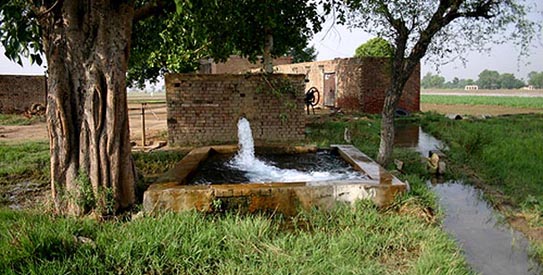
ISLAMABAD: The federal cabinet decided on Thursday to withdraw electricity subsidy on agriculture tubewells across the country and to install energy meters at all tubewells to ensure an optimum recovery of electricity cost. The decision will apply to Balochistan too.
There are more than 300,000 agricultural tubewells across the country. As most of them have no electricity meters, they are charged at flat rates subsidised by the power companies, provincial governments and the federal government. The annual subsidy on this account is estimated at about Rs5 billion. Tubewells consume 14 per cent of the total power supply consumption.
A meeting of the cabinet, chaired by Prime Minister Yousuf Raza Gilani, directed the power ministry to ensure implementation of the loadshedding schedule during the coming canal closure when the gap between demand and supply was estimated to shoot up.
It was decided to observe two hours of loadshedding daily in urban areas and four hours in rural areas under a pre-announced schedule.
Information Minister Firdous Ashiq Awan told newsmen that since “performance of public sector corporations like PIA, Pepco, Pakistan Steel and Railways is not up to the mark despite grant of huge subsidies”, it was decided that the cabinet should meet every week, instead of every fortnight, to examine restructuring of these organisations.
The cabinet decided to refund general sales tax paid by power companies of Wapda against unpaid electricity bills. The meeting considered withdrawal of lower electricity rates facility in Azad Kashmir, but decided against it until the resolution of net hydel profit issue payable on account of Mangla dam.
The meeting, however, expressed a desire that the net hydel profit issue be settled with AJK immediately. The government will support Azad Kashmir’s demand for GST exemption on electricity bills.
KESC AFFAIRS: The cabinet directed a committee looking into the performance of Karachi Electric Supply Company to finalise recommendations and priorities at the earliest. The minister said a summary had been moved for capacity improvement of the National Electric Power Regulatory Authority (Nepra) to ensure efficient handling of the changing dynamics of a restructured power sector.
According to Information Minister Firdous Awan, the cabinet gave instructions for implementing decisions of the Economic Coordination Committee regarding gas load management.
It ordered that gas disconnection be applied to fertiliser, CNG and industry sectors for three days a week while ensuring that domestic consumers got uninterrupted supplies.
Ms Awan said there was a proposal to reduce gas load management for the industrial sector by diverting maximum shortage to the fertiliser sector, but since crop sowing was in progress, it was decided to prepare a load management plan in consultation with all stakeholders, ensuring equal treatment to all sectors.
This means gas supply to the fertiliser sector will remain in place at least until the next meeting of the cabinet.
The meeting was informed that Sui Northern Gas Pipelines had added 35,000kms of pipelines for new connections at a cost of Rs80 billion during the past five years. Likewise, the Sui Southern Gas Company had laid 14,000km of pipeline at a cost of Rs43 billion during the same period, resulting in a substantial increase in consumers and the gas demand.
She said all new consumers wanted to get domestic connections even though some of them fell in other categories.
The minister said the cabinet expressed concern over a Supreme Court decision about employees of the defunct National Commission for Human Development. She said it was a matter of concern as to how a decision of the federal cabinet, endorsed by the Council of Common Interests with consensus, be reversed by the apex court. Therefore, the cabinet directed the ministry of finance to apprise it in the next meeting how to meet the financial burden arising out of the SC order.
The cabinet accorded approval for starting negotiations on Mutual Recognition Agreement, Agreement on Redressal of Grievances with India and Preferential Trading Agreements under Safta. In the sixth round of commerce secretary level talks last month, the two sides had discussed the process of trade normalisation further.
The cabinet reviewed implementation status of its decisions pertaining to the Economic Affairs and Establishment Divisions. The cabinet was informed that 5,242 contract and 876 daily-wage employees have been regularised.