0
0

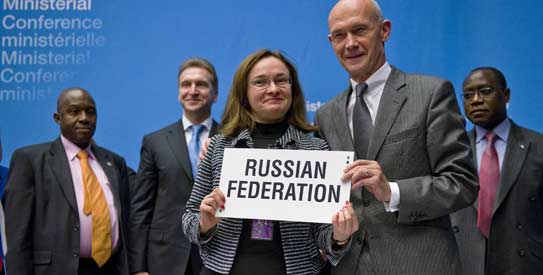
GENEVA: Russia secured the final approval Friday to join the World Trade Organization after a record 18 years of trying.
The WTO’s 153 members gave their second and final approval for Russia’s membership bid, ushering in the last major economy outside the trade club.
The Russian parliament will have until June 15 next year to ratify the accord and bring it into force.
Moscow’s lead negotiator Maxim Medvedkov had said earlier that he expected the deal to be ratified “early next year.”
“This is clearly a historic moment for the Russian Federation and for the rule-based multilateral system after an 18-year marathon,” said Pascal Lamy, director-general of the WTO.
“What you have to know about marathons is that the last mile is the worst and toughest and the best moment is when you cross the finishing line which is what we are doing today,” he said.
Describing the accession as a win-win for both the WTO and Russia, Lamy said it “accords the quality WTO label” on Russia and with the membership the trade body would cover 97 per cent of world trade.
Making a reference to the storm over Geneva, Russian First Deputy Prime Minister Igor Shuvalov welcomed the accession saying: “The storm is a sign of a wind of change – change for the better.” Russian Economic Development and Trade Minister Elvira Nabiullina said after the signing of the deal that she hoped discriminatory export measures, currently costing Russia $2 billion a year, would be lifted.
Nabiullina told a news conference that the chemical and transport industries would be the biggest winners.
“Everyone is going to win,” Shuvalov added. “There won’t be any losers.” The minister said Russian consumers would benefit from the increased competition that WTO membership would bring, with better quality goods and lower prices.
Moscow also said it was ready to counter any threat of protectionism as part of the WTO.
“The world economy is living through not the best of its times. The risks of protectionism are always looming in the horizon. By joining the WTO we are ready to counter these risks actively,” Nabiullina said.
US President Barack Obama congratulated his counterpart Dmitry Medvedev on the accession in a telephone conversation during which both parties “agreed to continue working efficiently to strengthen the potential of bilateral cooperation,” said the Kremlin in a statement.
“The two heads of states also underlined the great importance of this event, as they believe that it has set the foundation for a strong enhancement in bilateral economic cooperation,” it added.
Russia applied to join the trade body in 1993 but talks dragged on and its brief war with Georgia in 2008 further delayed its application.
No other country has had to bargain so long before being granted entry.
China was the previous record holder with 15 years of negotiations for membership.
Moscow cleared its last hurdle for WTO accession when it finally clinched in November a deal with last hold-out Georgia, which was able to veto any accession bid by virtue of its membership to the trade body.
In all, Russia sealed 30 bilateral agreements on market access for services and 57 on access for goods to secure the green light from other WTO states.
For the overall package, Moscow agreed to cut its tariff ceiling from the 2011 average of 10 per cent for all products to 7.8 per cent.
The average tariff ceiling for agricultural products is cut to 10.8 per cent from 13.2 per cent currently, with manufactured goods at 7.3 per cent, down from 9.5 per cent.
Russia also agreed to limit farm subsidies to $9 billion in 2012 and to gradually reduce them to $4.4 billion by 2018.
Six demonstrators were seen on Friday outside the ministerial conference hall braving the rain and gale-force winds holding posters saying: “WTO, Russians protest.” Meanwhile, the United States invoked a clause under the WTO rules to point out that it was unable to treat Russia equally as other WTO member states unless it obtained approval from Congress to do so.
The move is not unusual, as the Jackson-Vanik amendment adopted by Congress prevents the federal government from according the so-called Most Favoured Nation status to politically sensitive countries.
However, Russia, in a retaliatory move, decided to invoke the same clause against the United States, marking the first time that an acceding country was using the recourse.