0
0

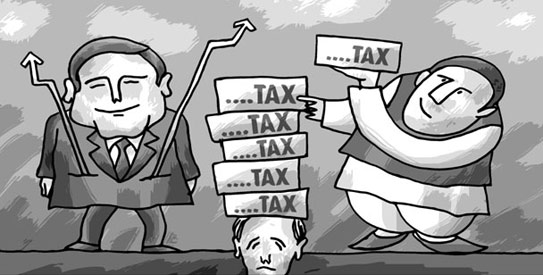
As the economy groans under the pressure of a rising budget deficit worsened by falling foreign financial inflows and the tax-to-GDP ratio, the elite should brace themselves to answer the knock of the desperate taxmen at their door. It is time to acknowledge that indirect taxes that provide bulk of the tax revenue, already cutting into the bones of the average households, have ceased to be an option.
“The stabilisation rhetoric has backfired. All said and done, the tax-to-GDP ratio has actually dipped from 11 to eight per cent over the past few years of slow economic growth. It is sad that those who have toiled to create national wealth will be forced to pay for follies of the political elite,” said a textile tycoon expecting a harsher treatment by the tax administration in the period ahead.
There is no way to go on funding a growing national budget, currently at Rs3 trillion, with tax revenue of about half of its requirement or a little over one and a half trillion rupees.
The petty contribution, post devolution, of all provinces at less than one per cent of the GDP is not justifiable and will have to be improved.
The Gilani government still recovering from a series of political crises might find it difficult to survive a feared dramatic economic meltdown. The government seems set to cut corners and stretch the sheet to balance the budget.
“To me completion of five-year term by the elected government essentially hangs on the ability of the leadership to negotiate a new deal with power brokers defining features of new tax sharing formula,” commented a retired civil servant.
However, while the elite maintains an uneasy calm waiting for miracles to happen, the government has opted to act unilaterally without going through the difficult path of much needed intensive consultation in or outside the parliament.
The recent decision of the government to withdraw electricity subsidy on 300,000 tube-wells and to install energy meters to ensure recovery of electricity cost, needs to be seen in this context. Currently tube-wells are charged at flat rates and enjoy subsidy worth about Rs5 billion. The share of tube-wells in total power consumption is 14 per cent.
Federal Minister for Finance Dr Abdul Hafeez Sheikh last week said the government had decided to go after tax evaders who own properties and travel abroad frequently.
“We will go after these 700,000 evaders and collect taxes from them as the country cannot progress without growing tax revenue,” he was quoted to have said.
The tricky question is as to which segment of the elite, rural or urban or both will be targeted to collect the required tax revenue.
“I do not see a major breakthrough in resource generation unless traders, realtors, importers and shop-owners are taxed. The FBR is making efforts to plug holes and streamline administration but a significant improvement looks improbable unless the tax base is broadened,” Syed Shabbar Zaidi, partner at A. F. Ferguson and Company and an advisor to Federal Board of Revenue, told Dawn over telephone.
The representatives of the business community resent the very idea of an additional tax on existing tax-payers who, they feel, have been at the losing end all along the past nearly four years of Pakistan People’s Party government.
“I know it for a fact that there has been a net transfer of wealth from urban to rural economy over the past few years. I personally know people with rural land holdings who have done very well. The commodity prices have increased and the commodity producing sector reaped profit. It is time they are asked to chip in their share in tax collection,” Kamran Y. Mirza, President Pakistan Business Council, said.
He appreciated the decision of withdrawal of power subsidy on tube-wells but found it more to be symbolic. “Well I am not sure how the decision is played out. Installing of electricity meters at tube-wells at farms scattered all over the country is difficult, and the actual collection may prove too costly an exercise,” Mirza added.
Zaidi was not convinced. “For too long we neglected the huge rural economy, so even if there has been net transfer of wealth from urban to rural sector it will serve to address the income disparity. In fact we need to transfer more resources to agriculture for productivity gains and for ensuring food security. If the government needs resources it should tax retail and real estate sectors,” he said.
“The government will tax traders as it does not enjoy any constituency in this class,” a tax consultant felt. “The PPP cares two hoots if cities simmer as its vote bank is not located there.”
“With MQM as coalition partner and PML(N) in the opposition, both representing urban constituencies of Karachi and Punjab, it will be hard for the government to tighten the tax-noose around traders and importers,” another public finance expert said.
“The long honeymoon of rich and powerful (landed and urban elite) is coming to an end. For decades they had full liberty to multiply their wealth and enjoy near complete immunity from tax liability. The country can no longer afford to pamper the pampered,” said an observer.
In the current environment, the government will need to heed to the Federal Fiscal Responsibility Act. As fiscal challenge deepens, all public expenditure will come under scrutiny and tax collection regime will have to be made just and equitable, to nurture tax culture.
“The days of easy access to foreign money—- by selling a cause or a crisis—- are behind us. For too long, the country has begged and borrowed to support perks and privileges of the elite,” an analyst said.
Pakistan has high income disparity with skewed asset ownership. The tax regime continues to be regressive. The direct taxes contribute hardly four per cent of the GDP with many exemptions to powerful segments.
A major chunk of tax receipts is raised from sales tax that disproportionately burdens the poor who spend their entire income on consumption of bare essentials. Low resource generation is often attributed to the fact that some of the major segments of the economy such as agriculture, real estate and a part of the services fall in the provincial domain and remain inadequately taxed.
The lack of political will and weak tax machinery at provincial level leaves these lucrative avenues largely untapped.
The farm sector that makes over 20 per cent of the national income(GDP) virtually pays no income tax. And of the two million tax payers, 1.8 million are salaried whose tax is deducted at source.