0
0

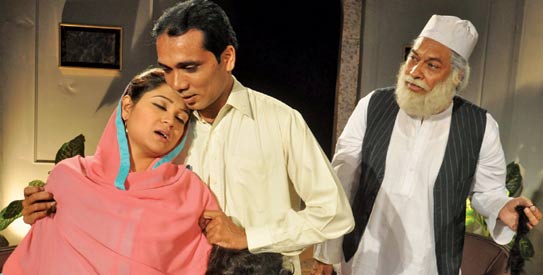
Playwright Agha Hashr’s Naek Perveen reminds you of the rigid lessons learnt at the end of didactic plays that tend to turn a man into an angel – but not a human being.
The lessons include one on the ideal wife, in which she worships a drunkard husband, a tyrant and an evildoer (probably) because he has bestowed upon her conjugal rights, which she can never be ungrateful for. Since women in the most pious (and naïve) form have no other business in life but to marry because, well, they have nothing better to do in life.
For the conformist, Naek Perveen is a stark reminder of yesteryear when women were safely (but suffocatingly) tucked into chador and chaardivari because that is where their place was. However, the play runs the risk of being rejected by modern-thinking women and activists who have a lot better to do today than to wait for a drunkard, dejected husband to restore and rehabilitate.
Sleazy men, who offer her the world if she yields, tease Naek Perveen but her religious sense of commitment towards her husband remains undeterred – until the playwright, Hashr, rewards the character for its patience. For the likes of Hashr’s times (this play was written in 1910 and later performed under various titles), there was room for human improvement and forgiveness.
Directed by the master of the art, Zia Mohyeddin and assisted by the upcoming and promising artiste Akbar ul Islam, Naek Perveen will offer audiences the most beautiful language in the form of hyperbolic dialogues, if not an original plot. Agha Hashr was famous for employing a Shakespearean technique in his plays – he was known as the ‘Indian Shakespeare’ of his times.
“I have not touched the play even slightly,” confessed Mohyeddin, “as nothing seemed unfulfilled in the script.”
While the heightened melodramatic appeal in Hashr’s plays is a challenge for performers, NAPA’s selected cast has done justice to Naek Perveen in terms of delivery of dialogue. The upsurge of emotional content that “tear a passion to tatters” as quoted by Mohyeddin, and “split the ears to the groundlings” seem well actuated by the actors.
Aimen Tariq renders the innocence and aplomb of Perveen’s character quite skillfully; luckily the television fatigue (she has been appearing in a plethora of televised plays these days) has not tampered with her love for theatre.
Nazrul Hasan (Afzal) acts a beggar and then a disabled man besides Perveen’s drunkard husband. How well he has managed to wear three hats one after the other, I shall leave it to the audience’s discretion.
As Paras Masroor (Asad, the partner in crime) seethes in rage, trying his negative best to rip Perveen of her piety, you tend to hate him more than Nabbu (Sunil Shanker) who is more of an impish buffoon than a murderer. Paras Masroor shows maturity in his potential for acting as he is able to bring out the bad man in him successfully.
Comic interludes are spread through the play amidst violence and venom spewed throughout. Mirza Chonga’s character (played by Athar Abbas) is well acted. He appears quite funny as he exchanges some very hilarious, tongue-in-cheek dialogues with his beautiful wife Zulfan (Faiza Hasan).
Naek Perveen will be performed by the NAPA Repertory Theatre Company from December 30th to January 8th at the Arts Council, Karachi.