3
3

Barely two weeks after the Senate passed women protection bills, two girls in Karachi became victims to yet another acid attack.
The bills are aimed at ensuring safety and security to women against crimes such as forced wedlock, acid attacks, marriage to the holy Quran and other anti-women offences.
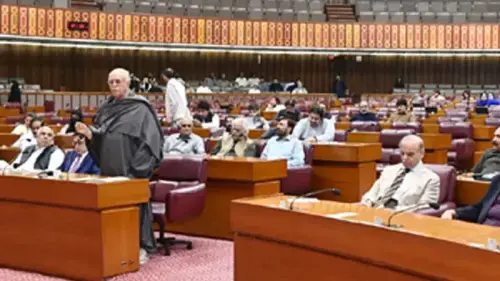
Senator Nilofar Bakhtiar moved the bills, which seek to amend the Pakistan Penal Code, 1860 and the Code of Criminal Procedures, 1898. The ensuing debate was focussed on ensuring that the so-called custodians of Pakistani laws follow the stipulations and clauses.
It is believed that the laws have always been in place but the practice has been missing, as the means to carry out these laws have either been obstructed by “elites” of the society, or that the bills were never meant to assist the victims.
Making it a law The Constitution of Pakistan empowers women but a lack of support from law-enforcers vetoes their power to demand their due share of rights. However, the formulation of policies and frameworks has come as a positive measure, which might result in constructive developments for women residing in urban and rural settings of Pakistan.
By passing the bills, the Senate has authorised social organisations to use the laws in helping the victims.
“The primary reason why we are able to help minor women, subjected to forced marriages, is because the law explicitly states that women under the age of 18 are not allowed to carry out legal transactions, including marriage and conversion,” says Dr Habiba Hasan, who is a founder member of the Panah Shelter Home.
Several other laws, she says, help women in obtaining justice and support social workers in providing relief to the victims.
The social workers and non-governmental organisations try to bring about positive behavioural change in the victims, by creating awareness about issues that have sabotaged their basic rights.
According to Hasan, several judges have been known to give an incorrect verdict because they themselves belong to the same society where women have been prejudiced for simply being a woman.
The role of law-enforcers The development of curriculum and training modules, to help law enforcing agents understand the problems faced by women can also help in devising mechanisms to facilitate the traumatised women.
“Gender sensitisation and curriculum development have been the top of our agenda since 2005 and we have collaborated with various judicial authorities to help us conduct workshops to change the general perception regarding gender discrimination” the shelter-home founder said.
Panah’s training is based on audio-visual presentations, which are conducted by professors and religious scholars affiliated with various prestigious institutions.
“So far the response has been quite uplifting. The personnel deployed at penitentiaries, police stations and various courts have described their respective experiences as “eye opening.”
Among the masses, there is a surprising lack of awareness about the mistreatment of women.
“Men believe women are to be treated this way, as they grew up denying women their birth and constitutional rights,” Hasan says.
“The transformation will take time as Pakistan is still a transitional society. However, I am pleased to say that our experience with the local police agencies has been extremely positive.”
‘Just a piece of paper’ Former parliamentarian and a vocal supporter of women’s rights, Marvi Memon believes the bills will remain a piece of paper unless they are implemented in totality.
“The sitting government and parliament will have to take ownership of the bills, especially the ministers of National Assembly (MNA) governing various rural establishments.”
Memon believes the MNAs should be held responsible and accountable for maintaining law in their respective territories.
“Failure or success of these bills,” she says “depends on their actions.”
Women as equals According to Justice (retired) Nasir Aslam Zahid, “the state of affairs will remain the same unless we stop treating women as “chattel”. They are not to be used as articles or commodities of our personal use.”
The former judge blames lack of education and the denials of social empowerment to women, for the deplorable treatment of women in Pakistan.
“It is important to change the mindset of the civil and social societies in order to prevent further deterioration of the situation.
Homing on the points raised by former MNA Memon, the former judge said that bills and articles cannot be implemented unless judiciary and law-enforcement agencies work together.
The writer is a reporter at Dawn.com