34
34

When I draw correlations between Pakistan and the United States, many readers have commented that no such similarity can ever be made, as the two countries are incomparable. While usually I disagree, their point is well taken in the context of the political and consumer cultures in both countries, which are polar opposites.
The American consumer culture is predisposed to replacing a broken product instead of refurbishing it, whereas Pakistan’s consumers demand ingenious repairs to keep products functioning far past manufacturer expectations. Conversely, America’s political culture is inclined to repair any malfunctions that arise through democratic rule, while Pakistan’s people repeatedly scrap democratic regimes and “start fresh” out of frustration at politicians who fail to satisfy their needs.
The United States has an obsessive quality about replacing broken items, partly because consumers often have limited options for repair. Though there are repair shops across the country, they pale in comparison to the amount of retail stores that dot the American landscape offering new items. With so many stores competing against one another, the cost of new items is lowered and becomes an obvious choice for many consumers. Computers are perhaps the best example, where the cost of repairing a laptop is sometimes greater than or equal to the price of a new one.
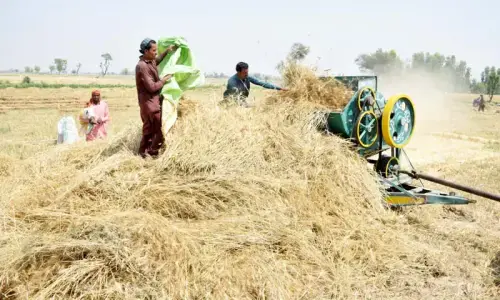
This is a far cry from Pakistan, which I noticed during my last trip to the country. The ratio of repair shops to retails stores was astounding to me not only in metropolises like Lahore, but also smaller cities like Sahiwal. Even my father’s village had a repair shop for almost every product used by people, including footwear, farming equipment, and cell phones. The practice of most people was to repair an item to keep it functioning, and with such a large amount of repairmen competing to serve the public’s demand, it is far more inexpensive to repair an item rather than replace it.
The political culture in the United States resembles Pakistan’s consumer culture, where there are repairmen at every corner and salesmen are seen as outliers. The US Constitution is one “product” that has withstood the test of time. Even in the aftermath of a Civil War that threatened to break the nation in two, there was no suspension or major alteration to the document. The Constitution, and the democratic system it prescribes, has remained a central and unchangeable part of the American political culture.
However, the document has evolved along with the society. In the aftermath of the Civil Rights Movements, where leaders like Martin Luther King Jr. were accepted by mainstream America, the demands for equality were met by a constitutional amendment. The Civil Rights Act guaranteed equal rights to all races, and was used to amend the apartheid African-Americans suffered under following slavery.
It is interesting to note that Mr. King’s contemporary, Malcolm X, is now cast as a fanatic because he believed the American democracy was built and fueled by the enslavement of minorities, and thus could never be amended to any just end. Rather, he argued that the system had to be replaced all together, and for that, he is remembered as an enigma of American history rather than a critical mind.
The American political culture not only prefers those willing to “play ball” with the existing system, but also castigates the others who question its foundation. This has led to a stable system, albeit dysfunctional and unjust at times, but a system that applies laws consistently. While there is a rising chorus of voices challenging the foundation of the government like the Tea Party or Occupy Wall Street, it is important to note that most do not advocate for the suspension of the Constitution or the immediate removal of Congress.
The same cannot be said for Pakistan, where people seem to be attracted to the melodrama of intense power-politics. Every decade plays host to some sort of upheaval in the country, whether it is through the dissolution of a civilian government, a military coup, or the reentry of elected officials. The pattern seems to continually repeat itself, but one would be unfair in blaming the ‘awam’ or public for the fact that the nation lacks democratic repairmen, yet has a slew of salesmen inundating them with offers of “alterative, new, corruption-free” systems.
The blame cannot be afforded to any one party, but the military has certainly fostered a spirit amongst the people that calls for the ouster of democratic regimes rather than allowing them time to develop.
Today is no different, as supporters of PTI and the military are calling for the ouster of the civilian government to hold new elections. This comes as the civilian-military showdown has heated up and after PM Gilani and President Zardari’s attempts to place civilian oversight on the military. One cannot help but correlate the rising calls to eject the government with attempts by the military to, once again, convince the public to replace rather than repair its civilian governance.
But the elected politicians have certainly not been innocent in the game of losing the public’s trust; civilians have also used the document to malign political rivals. On top of this, while some politicians can validly refute claims of corruption as mere lies spread by the military, many leaders are not so innocent. The deplorable state of poverty and crime in the nation is proof that there is either rampant corruption or government inaction to blame. But this is just one example of many in Pakistan’s history of civilian governments, who mismanage the country’s affairs to such an extent as to warrant questions about its capability to lead the people.
There is certainly value in critically examining the services and capabilities offered by elected officials, but long-term prosperity cannot be developed in a democratic system unless it is given time to mature. Though the American public shuns most revolutionaries who challenge the foundation of their society, the respect awarded to the Constitution allows people to consistently express their political views at ballot box. If the same could be said for Pakistan, Imran Khan would have banners reading “Vote for Imran 2013”, rather than chants of “Go Zardari Go” dominating his rallies.

The views expressed by this blogger and in the following reader comments do not necessarily reflect the views and policies of the Dawn Media Group.