0
0

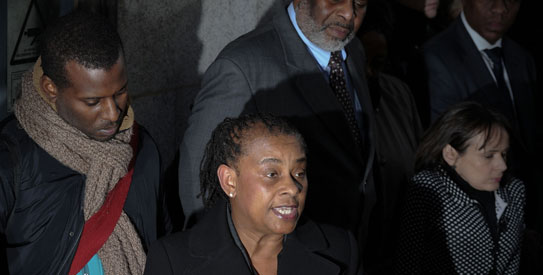
LONDON: In a case that exposed racism and incompetence in Scotland Yard and took nearly two decades to bring anyone to justice, a jury found two men guilty of brutally stabbing a black teenager to death.
Gary Dobson, 36, and David Norris, 35, were convicted on Tuesday of killing 18-year-old Stephen Lawrence as he waited for a night bus in southeast London in 1993. The pair will be sentenced Wednesday and face life in prison.
''Had the police done their job properly, I would have spent the last 18 years grieving for my son rather than fighting to get his killers to court,'' said Lawrence's mother, Doreen, who said Tuesday's verdict was tinged with sadness.
The investigation _ which has seen multiple court appearances by suspects over the years but no convictions until now _ led to strong criticism of London's Metropolitan Police and resulted in an investigation that found the force was ''institutionally racist'' and had bungled evidence-gathering. It also led to a change in Britain's double jeopardy rules.
It has been one of the most notorious unsolved murder cases in Scotland Yard's recent history _ and police admit the investigation isn't over yet.
Lawrence, who had wanted to study architecture, was stabbed twice and bled to death as he stood at a bus stop with his friend Duwayne Brooks. He was attacked by a gang of youths and police say they believe others were involved in the stabbing.
''I do not think I'll be able to rest until they are all brought to justice,'' Lawrence's father Neville said in a statement read out by his lawyer after the verdict.
Arrests weren't made until two weeks after the murder. Then _ in 1996 _ three of the suspects _ Neil Acourt, Luke Knight and Dobson _ were acquitted.
Tireless campaigning from Lawrence's family _ and a change of government in 1997 _ helped keep the case alive, with Britain's left-leaning Labour Party commissioning a public inquiry into the murder and the police investigation.
The resulting report, written by William Macpherson, found that the police were ''institutionally racist'' and had failed to investigate Lawrence's murder carefully because he was black.
The Macpherson report led to a sea change in British race relations _ and breathed new life into the prosecution after authorities relaxed England's rules on double jeopardy, which say that a person cleared of a crime cannot be retried for the same offense. Still, obstacles remained.
In 2004, prosecutors announced there was ''insufficient evidence'' to pursue anyone for the murder amid allegations of police corruption.
But new forensic evidence uncovered in 2007 helped save the case.
Scientists subjected the evidence to months of careful tests, retrieving fibers from clothing taken from the suspects. They found a single hair matching Lawrence's DNA and a microscopic blood stain invisible to the naked eye.
In 2011, a new trial was set up at London's Central Criminal Court.
British Prime Minister David Cameron said Tuesday he hoped the conviction would offer some comfort to Lawrence's family.
He said the verdict would not ''ease the pain of losing a son, but ... I hope that it brings at least some comfort after their years of struggle.''
Labour leader Ed Miliband said he believed the Lawrence case would leave a powerful legacy for Britain.
''The murder of Stephen Lawrence was not only a tragedy for a talented young man and his family, it was a wake-up call to all of us who believe Britain is _ and always must be _ a country where everyone is shown respect irrespective of race, culture or faith.''
Dobson and Norris had both denied the charges. After the verdict, Dobson said as he was leaving the court: ''You have condemned an innocent man here; I hope you can live with yourselves.''