0
0

ISLAMABAD, Jan 13: It may not be an indicator of political strength or weakness but surely a sign of lack of focus on an economy whose weaknesses are troubling most people irrespective of their political affiliations.
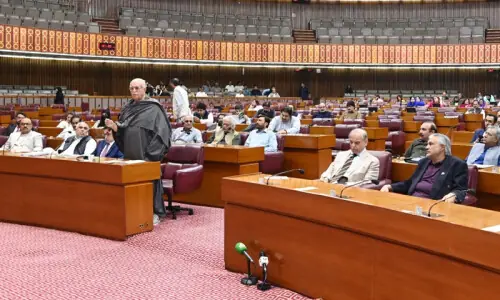
Amid high political drama surrounding the ‘memogate’ scandal and the National Reconciliation Ordinance, an event arranged by the government for an all-party briefing on the state of economy and the challenges it faces attracted only seven parliamentarians, all of them from the ruling Pakistan People’s Party.
A parliamentarian, who attended the briefing arranged by the ministry of finance on Thursday, told Dawn that the government had invited four members -- two each from the Senate and the National Assembly -- from all parliamentary parties and a number of parliamentarians from the PPP. A total of 55 accepted the invitation.
To utter disappointment of Finance Minister Dr Abdul Hafeez Shaikh, only seven members from the PPP turned up. No senator or member of the National Assembly from the opposition or coalition partners attended the event, where the finance ministry pulled together about 25 senior officials of the finance and economic affairs divisions, a participant said.
Prominent among those who attended the meeting included PPP secretary general Jehangir Badar, chairperson of the National Assembly’s Standing Committee on Finance Fauzia Wahab, Ayatullah Durrani and Minister of State for Production Khawaja Shiraz Mahmood.
As a result a media briefing on the meeting was cancelled and instead an official handout was released describing the success stories, failures and challenges. According to an official, except for camerapersons to cover only the start of the proceedings, the ministry had not invited journalists and hence the question of cancellation of the press briefing was hypothetical.
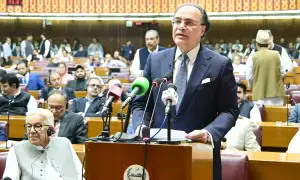
The finance minister, who was assisted by Finance Secretary Dr Waqar Masood Khan, told participants that the most worrying issue for him was a fresh analysis that international oil prices were heading towards $130 per barrel from less than $110 a few weeks ago. It could put additional burden on economy and reverse outcome of some of the stabilisation measures.
The most important contingency plan which the economic team shared with political leaders and sought their support for was bridging a price gap between expensive petroleum products and cheap natural gas as it is creating a distortion in pricing mechanism and hence a higher demand for limited gas reserves, creating supply shortages and public unrest.
The meeting was informed that the government was pursuing liquefied natural gas (LNG) imports whose price hovered around $18 per MMBTU, compared with a maximum domestic gas price of $6 and alternative furnace oil cost of over $20. Since the three fuels are generally used for similar purposes, their prices should also have some compatibility.
Talking about the existing challenges, Dr Hafeez said that while controlling expenditure in running the civil administration had been a key policy direction, this could not apply to security expenditure in view of the security situation.
He said rains in Sindh required the government to lower economic growth forecast from 4.7 to 3.6 per cent.
When Fauzia Wahab asked why efforts had not been revived to introduce value-added tax abandoned in March last year, a parliamentarian quoted Dr Hafeez as saying: “It is a matter of political arithmetic that is perhaps missing.” He said a lot of effort, time and energy had gone waste last year, leading to introduction of other policy measures that helped recover over Rs40 billion.
DIVISIBLE POOL: The minister said that after the inclusion of special grants to Khyber Pakhtunkhwa and Balochistan, about 60 per cent of total proceeds of the federal divisible pool was going to the provinces, leaving only 40 per cent in the hands of the federal government to deal with debt servicing, security, development and other running expenses.
Such a huge additional transfer of almost Rs800 billion to the provinces, although not liked by many, would have a positive impact on the common man.
Dr Hafeez reassured participants that foreign exchange reserves would remain around the $18 billion threshold, notwithstanding a recent dip below $17 billion and a major repayment of $1.2 billion due next month to the International Monetary Fund that was well accounted for in the budget.
The hope was based on an expectation that besides remittances and export earnings, which were estimated to yield $36.5 billion this year, about $2.4 billion would flow in before the end of the current fiscal on account of the Coalition Support Fund ($850 million) by the US, clearance of $800 million by UAE’s Etisalat on account of PTCL proceeds and $800 million on account of third generation telecom licences.
Dr Hafeez said the mismanagement in Pakistan Steel and PIA had symbolic importance and should be addressed, but they did not have any significant adverse financial impact on the budget. He said restructuring philosophy involving financing or refinancing of their debt and receivables would be a luxury with the public finance because this did not have any nexus with betterment of poor people.
On the contrary, Pakistan Railways and the power sector posed significant challenge not only to the budget but also to the overall economy.
The meeting noted with concern the railways minister’s demand, instead of in-house correction, for cash when the government was already taking care of railways’ salary, pension and electricity bills.
The minister said inflation had come down and expressed the hope that it would ease pressure on prices over the next couple of months. He said the government’s borrowing from the State Bank stood at Rs80 billion during the first six months (July-Dec) this year, compared with Rs123 billion during the same period last year.
Dr Hafeez said since the government was unable to meet fertiliser plants’ gas demand, it had decided to import 1.2 million tons of fertiliser to protect farmers. This put an additional unbudgeted subsidy of Rs40-50 billion, he added.