0
0

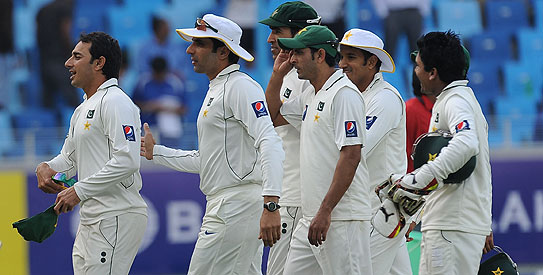
LONDON: Pakistan off-spinner Saeed Ajmal was tested in 2009 in Australia and we have used the same methods for many bowlers across the world, says Dr Paul Hurrion, the International Cricket Council (ICC) Head Biomechanics Analyst.
“The process is very robust. We use a big enough sports hall so the bowler can make his typical run-up and bowl a full-length delivery. It is important to replicate what it is like in the middle as best we can,” Dr Hurrion said.
Possessing a variety of deliveries in his rich armoury, Saeed grabbed a career-best 7-55 to topple England’s batting in their first innings on the opening day of the first Test at Dubai on Tuesday.
The magnificent effort by Saeed, however, drew suspicions over his ‘doosra’, a delivery an off-spinner turns like a leg-break, mainly from former England Test fast bowler Bob Willis. But the ICC official elucidated in technical terms the scientific procedure, which he described was the best available option presently, to test a bowler’s action, implying the same was employed before clearing Saeed’s action in 2009.
“There are stumps to aim at but no batsman and we use synchronised footage of the player bowling in a match to check that they are not just going through the motions or altering their style. They have to replicate the speed of a delivery from a match, the deviation and the revolutions of the ball,” the ICC official added.
“When being tested, the bowler is topless and has reflective markers all over his bowling arm, so the 3D, high-speed cameras can film him from every angle. On TV, what you see is an optical illusion because the pictures are only 2D so the angle you see is often very different from the reality.
“We then check if the arm is bent more than the permitted 15 degrees, which we decided was appropriate as anything under that would be hard to see with the naked eye,” the official explained.
“Of course, until technology is good enough to have X-ray cameras from the boundary at a live game we can’t ever be 100 per cent sure that our testing is perfect. I’m sure in 10 years’ time there will be the technology to test as the game is happening,” Dr Hurrion remarked.—Agencies
LONDON, Jan 18: Pakistan off-spinner Saeed Ajmal was tested in 2009 in Australia and we have used the same methods for many bowlers across the world, says Dr Paul Hurrion, the International Cricket Council (ICC) Head Biomechanics Analyst. “The process is very robust. We use a big enough sports hall so the bowler can make his typical run-up and bowl a full-length delivery. It is important to replicate what it is like in the middle as best we can,” Dr Hurrion said. Possessing a variety of deliveries in his rich armoury, Saeed grabbed a career-best 7-55 to topple England’s batting in their first innings on the opening day of the first Test at Dubai on Tuesday. The magnificent effort by Saeed, however, drew suspicions over his ‘doosra’, a delivery an off-spinner turns like a leg-break, mainly from former England Test fast bowler Bob Willis. But the ICC official elucidated in technical terms the scientific procedure, which he described was the best available option presently, to test a bowler’s action, implying the same was employed before clearing Saeed’s action in 2009. “There are stumps to aim at but no batsman and we use synchronised footage of the player bowling in a match to check that they are not just going through the motions or altering their style. They have to replicate the speed of a delivery from a match, the deviation and the revolutions of the ball,” the ICC official added. “When being tested, the bowler is topless and has reflective markers all over his bowling arm, so the 3D, high-speed cameras can film him from every angle. On TV, what you see is an optical illusion because the pictures are only 2D so the angle you see is often very different from the reality. “We then check if the arm is bent more than the permitted 15 degrees, which we decided was appropriate as anything under that would be hard to see with the naked eye,” the official explained. “Of course, until technology is good enough to have X-ray cameras from the boundary at a live game we can’t ever be 100 per cent sure that our testing is perfect. I’m sure in 10 years’ time there will be the technology to test as the game is happening,” Dr Hurrion remarked.—Agencies