1
1

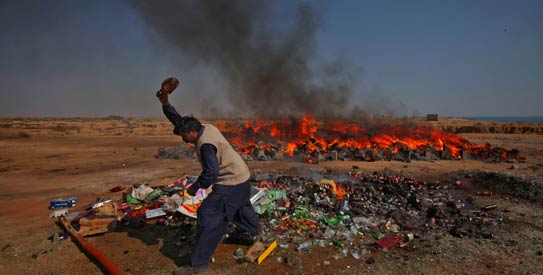
KARACHI, Jan 26: Government agencies must stop burning narcotics and other seized material in the open, particularly near the beach, as it’s a big environmental hazard, said experts from different fields while expressing their concern over current drug destruction practices.
They also highlighted the need to include an independent third party in the process of burning narcotics to ensure if the material actually being set on fire constituted drugs.
The experts shared these views while speaking to Dawn about the drug destruction ceremony, which was organised at Hawkesbay by the Model Customs Collectorate of Prevention (Karachi) on Thursday to observe International Customs Day.
The customs department claimed that the destruction was witnessed by officials of the Environment Protection Agency, Anti-Narcotics Force, Coast Guards and Maritime Security Agency, though the director general of the Sindh Environment Protection Agency denied that their representative was present at the event.
According to a customs department press release, 300 kilos of heroin, 1,280 kilos of hashih, 428 bottles of liquor, 343 cans of beer, confiscated medicines, DVDs and CDs along with a huge quantity of gutka were destroyed at the Neelum Point, Hawkesbay, on Thursday.
It is interesting to note that there was no pungent smell emanating from the burning narcotics at the scene and, according to media personnel present at the function, nobody questioned the officials about the veracity of their claims.
Speaking to Dawn, Shahid Lutfi, a former deputy director of Sepa (Sindh Environment Protection Agency) now working as a private consultant, said that the beach wasn’t a suitable place to burn narcotics.
“Burning of narcotics in the open is against all environmental norms,” he said, adding that the agencies should take care of all long- and short-term problems that might develop from such non-friendly disposal of hazardous material.
“It’s surprising why these agencies do not make use of the incinerators being run by the city district government,” he said, asking if the people concerned knew where the smoke from the burning material was actually going.
“The winds from the sea are directed towards the land. There are also concerns regarding the disposal of the ash and the material, which is not completely burnt. By this method you can hardly take temperature up to 400 degrees centigrade and there is a strong possibility that many things may not be destroyed,” he said.
He said the capacity of the city government incinerator was one tonne per hour and this material could easily be burnt there. A place near the Jam Chakro and Gaund Pass landfill sites was another option, he added.
Referring to international norms, Prof Dr Nasiruddin Khan, a senior teacher at the Karachi University chemistry department, said that the disposal of narcotics was the same as that of medicines and they were burnt in dual-chamber incinerators installed far from populated areas.
“We are burning chemicals in the open and endangering our environment and public health. The ash needs to be disposed of at a landfill site, keeping in view that it wouldn’t lead to contamination of underground water,” he said.
A major component of CDs and DVDs, he said, was polycarbonate and their burning meant creating carbon dioxide pollution.
“There is a dire need that the country develops a sound system for the disposal of electronic waste and the best option is to recycle the waste,” he said.
Sepa Director General Mohammad Nawaz Naseem, however, said that the agency had no “issues if the narcotics were burnt far from the populated area. There is no other option available.”
He denied that a Sepa representative was present at the ceremony at Hawkesbay.
Qamar Thalho, public relations officer of the customs department, agreed that the open burning of narcotics was an environmental hazard and there was a need for adopting hazard-free methods for disposal.
However, he said: “All agencies use the Neelum Point for this purpose after taking permission from the Pakistan Navy.”
He said that the guards stationed there ensure that the entire material was burnt out. The ash was spread at the site, the official added.
In response to a question why no third party is allowed to check whether drugs were actually being burnt, he said that complete transparency was adopted during the procedure and the stock was checked by drug liaison officers before burning.