0
0

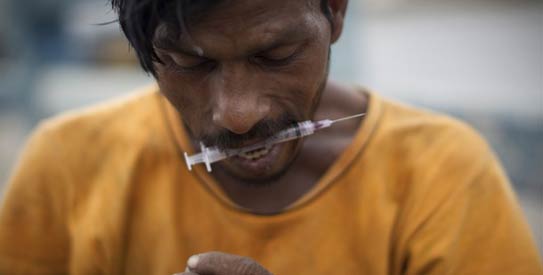
KARACHI, Jan 29: Unsafe injection practice among injecting drug users (IDUs) in Sindh, where various preventive programmes have worked through non-governmental organisations over the past many years, is still prevalent, say experts in the field.
According to recent reports on ‘2011 integrated behavioural and biological survey (IBBS)’ of the high risk HIV groups, almost one quarter (22.6pc) of the IDUs in the country reported that they passed their used needle/syringe on to other IDUs at their last injection, while 13.6pc of the IDUs reported that they used someone else’s injection paraphernalia.
In Sindh, “passing on of used syringes” was most common in Sukkur (69.3pc), followed by Larkana (29.7pc), Dadu (14.9pc) and Karachi (0.4pc), while the use of someone else’s syringe or needle was reported around 44.4pc in Sukkur, 20pc in Karachi, 12.6pc in Larkana and 5.7pc in Dadu.
However, when interviewed for the survey, 54.8pc of the IDUs at Karachi said they always used a new syringe for injecting during the last month. Over 60pc at Dadu stated that they used new syringes last month, followed by Larkana (22.2pc) and Sukkur (16.2pc).
The report mentioned that there had been an increase in the proportion of IDUs reporting injecting with used needle in 2011 when compared to previous years.
The reasons for this low number needed to be further explored but might be partially explained by cuts to service delivery programmes in certain cities, said a health official.
The IDUs injected with a used needle or syringe, largely for reasons reported as non-availability of a new syringe at the time of injection, the syringe was too expensive or the injecting partner did not think that it was necessary to use a new needle/syringe. The IDUs in Karachi constituted more than one-third (16,544) of the total IDUs (39,793) estimated in 19 cities included in the survey. Around 52pc of the IDUs were less than 30 years of age, while about two-thirds of the IDUs were between 25 and 40 years of age.
About 46pc of the IDUs lived with their family; 18pc lived alone and 35.5pc lived with friends. Over 2pc sold blood for money in the last six months. About 46pc of the IDUs in Karachi reported that they were married. Interviews with IDUs further revealed that 8.4pc of them travelled to Karachi from smaller cities.The lowest mean number (2.9 injections per day) was reported at Karachi against the highest mean number of 3.3 reported both at Larkana and Sargodha.
Talking about drug availability and its correlation to injection frequency, an expert said that heroin injecting IDUs needed to inject more frequently than those using other synthetic drugs. Among the cities of Sindh surveyed, heroin was the most common drug injected in Larkana.Referring to the exposure to acquired immunodeficiency syndrome (Aids) control initiatives or utilisation of preventives, the report said that the overall rate among the interviewed IDUs was low. However, the knowledge and utilisation of human immunodeficiency virus (HIV) special delivery packages was reported the highest in Karachi (84pc) in Sindh followed by Sukkur (38pc). HIV prevalence was found at the peak (42pc) among the IDUs of Karachi, where the highest number of IDUs was found (16,544), followed by Sukkur (19.2pc), Larkana (18.6pc) and Dadu (16pc).
In Karachi on an average the IDUs started injecting drugs at 24.3 years of age.
In particular, considering the rising HIV prevalence among the IDUs, low condom use and risky injecting practices, there is the risk of spillover into networks of sex workers and their clients, it was acknowledged by experts at the surveillance data dissemination meeting held in Islamabad last week.
Dr Saleem Azam, president of an NGO extending service delivery packages for the high risk HIV population in the city, said poverty, the need for rapid injections, social stigma that prevailed in the case of the IDUs were among the factors causing uses of contaminated or used needles and syringes for injecting drugs.
“Sometimes a gap in communication with the IDUs in parts of the city undoes the entire efforts as the drug users do not know the limits and walk into other areas. There is a dire need to have continuity in service delivery packages,” he said and referred to certain breaks in HIV-related works in high risk IDU groups moving in Baldia, Keamari, Lyari, Saddar and Jamshed towns and parts of the Defence Housing Authority and Clifton.
A viable solution to the needle-sharing problem could be the promotion of substitute substances taken without syringes, he said, adding the IDUs should be given the substances for oral use in a systemic way, along with education on the hazards of drugs and a state-sponsored rehabilitation mechanism to eliminate chances of unwanted syringe uses.
According to the 2008 IBBS, HIV prevalence among the IDUs was 20.8pc (averaged over eight major cities), an increase from 15.8pc in 2007 and 10.8pc in 2005.