0
0


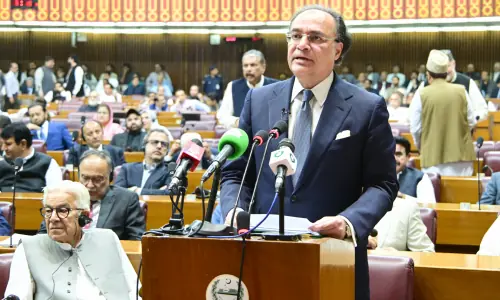
Wonders never cease to happen. And the full house of stock brokers, bankers, fund managers and investors heard with dis-belief — that Saturday afternoon — Finance Minister Dr Abdul Hafeez Shaikh, as he announced blanket approval of all proposals forwarded by the Securities and Exchange Commission of Pakistan for the revival of capital markets.
To revive a dying stock market, the SECP proposed a raft of measures including freezing the rate of Capital Gains Tax (CGT) at current levels. The government had indicated at the time of CGT implementation in 2010 that rates would go up every year for the next five years.
The SECP also proposed elimination of withholding tax on transactions to avoid double taxation, centralised collection and calculation of CGT at the National Clearing Company of Pakistan Limited (NCCPL) level to shield individual investors from the hassle of paperwork and interacting with the tax officials. Finally, the chief regulator was apparently able to convince the concerned quarters that investors had made legitimate but undocumented gains during the CGT exemption period (1974-2010) and hence the Federal Board of Revenue (FBR) should defer Section 111 of the Income Tax Ordinance, 2001 (reporting unexplained income or assets) on funds invested in stocks during CGT exemption period till June 2014.
The finance minister conceded: Rate of CGT to be frozen at financial year 2012 for two years (10 per cent for securities held for less than six months and eight per cent for securities held for less than one year; withholding tax, currently paid by investors at 0.01 per cent of sale value of shares, to be abolished; NCCPL to act as a withholding agent to deduct and deposit CGT from transactions; the highest value of an investor’s portfolio till June 2014, to be treated as his income generated from the stock market and a two year investment window until June 14, whereby everyone would be allowed to invest their undocumented gains in the stock market.
The most significant is an assurance that no questions would be asked about the source of funds to be invested in stocks till 2014 and to treat total wealth as white from 2014 onwards.
The two-year exemption window was met with cheers and applause of the stock traders who rushed into equities lifting the volume of trade to a one-year high of 230 million shares on Monday—the first working day following the amnesty announcement— from the earlier three-month average daily turnover of 52 million shares. Yet the cynics are aghast. “In granting such blanket amnesty to ‘ill-gotten’ wealth, the finance ministry has legalised money laundering through the stock investment,” objects one. And too many traders still suspect whether the taxman—always after a pound of flesh— would comply with the ministry’s suggestion. But the SECP chairman Mr Muhammad Ali contends that in finalising the proposals, the FBR was on board. “The finance minister could not have announced the acceptance of proposals without the consent of all concerned, including the FBR,” he said.
Syed Shabbar Zaidi, partner in accountancy firm, A.F.Ferguson & Co. and a member on the FBR Advisory Council, says that the proposals could have positive ramifications. He, however, added a caveat: It should not facilitate ‘whitening’ of ‘black money’. Alluding to the fixation of certain holding period, he said that unscrupulous elements should not be provided a conduit for undocumented wealth to be invested in stocks one day and come out clean the next day. Mr Zaidi believed that a two-year holding period may be good enough.
Chairman SECP when queried said there surely would be a minimum holding period for eligibility. “Discussions are on with the FBR and the government to determine what that minimum period should be,” he asserted. Mr Ali affirmed that the SECP proposals were crafted to facilitate all concerned. “It would help deepen markets and generate volumes, attracting new investment that would help in economic and industrial growth.”
He added that while investors would be enriched by bigger capital gains, the government would also be able to collect bumper cash in the form of CGT. The SECP chief pointed out that since the NCCPL would become the withholding agent for the FBR and it would calculate and deduct tax on behalf of investors, the government’s aim of documentation would also be achieved. But the NCCPL would need time to build the CGT calculation mechanism and amendments would be required to be made in FBR rules, which was why the CGT-related proposals have been put into place with a time lag, from April 12 onwards.
Analysts expect the proposals to be fully approved and incorporated in the Finance Bill, following budget FY12-13. Yet many questions remain unanswered. Mohammad Sohail, CEO at the Top line Securities says: “According to the SECP proposals, the tax authorities will defer the applicability related to source of unexplained income which will be calculated by arriving at the highest value of investor portfolio between April 2012 and June 2014.
However, besides the fact that there is no clarity on the holding period, the treatment to investments made before April 2012 also needs to be clarified.” Khurram Schehzad, head of research at Invest Cap argues: “It is unclear whether there would be any consideration/adjustment of capital losses that investors’ portfolio may entail in future, as income-based CGT means only tax on income.” Also clarity is required on question whether the CGT calculated by the NCCPL would be retrospective from June 20, 2011 or from its effective date, i.e. April 2012.
Never having experienced a stock market specific amnesty before, it is only natural that too many market participants eye all of it with a bit of suspicion. A broker articulated: “It looks too good to be true”. And many shy and the nervous among investors said that words were not enough. An early official notification (SRO) by the government could set their concerns at rest.