0
0


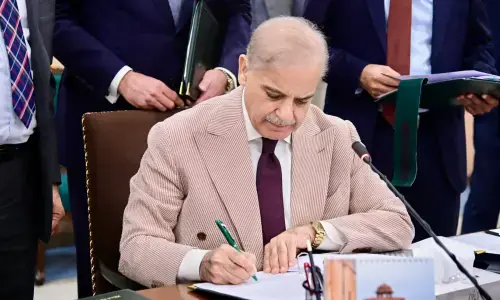
WHILE publicly projecting a sound fiscal position, the country’s economic managers have privately informed the prime minister and the ruling lawmakers that all was not that good on the econo-mic and fiscal fronts.
They have been cautioned that politically motivated economic steps may have already enhanced risks to inflation, investment, national currency and above all, the growth. Opportunities, however, were still there to stop further deterioration provided temptations to win looming general elections, through economic leverages, are kept in control. A big question mark though.
The key conclusion of the recent closed-door briefings to the PPP parliamentarians and the prime minister has been that revenues are too short to meet overall expenditures, even to pay off salaries.
“Almost all revenues available to federal government (after transfer of revenues to the provinces) are spent on interest repayment and defence. The government has to borrow to pay salaries of its employees, operate ministries, provide services, pay subsidies on electricity, income support programme, flood relief measures, provincial grants other than the NFC and public sector development programme, Finance Minister Abdul Hafeez Shaikh was quoted as saying.
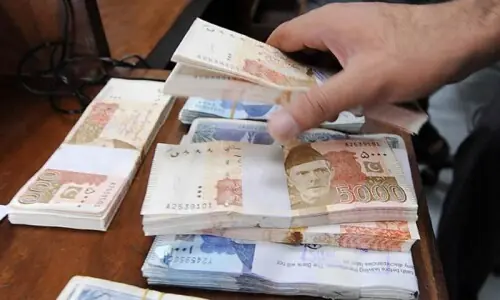
According to official account, the overall debt stock with the central bank increased from Rs1.154 trillion (end June 2011) to Rs1.277 trillion as on December 31, 2011. The reason for higher borrowing was less dependence on commercial banks in this period. Government borrowings from commercial banks in first quarter of current fiscal were Rs223 billion, dropping to Rs92 billion in second quarter.
It has been difficult to control fiscal deficit over the past many years but many other countries have also been facing similar difficulties. For instance, India’s budget deficit is likely to be above five per cent of GDP in 2011-12 as compared to 4.6 pronounced during the budget.
Pakistan government “has been trying to contain the budget deficit to 4.7 per cent of GDP (Rs985 billion).”
This is based on the presumption that budget deficit in first six months of the current year was 2.6 per cent (excluding consolidation of arrears of Rs390 billion) as compared to 2.9 per cent of GDP in the corresponding period last year. To finance Rs985 billion targeted deficit, the government will borrow from commercial banks, National Savings Schemes and international lenders.
While in public the economic managers have been expressing hopes to realise major budgeted inflows, the prime minister was warned about six major risks in controlling fiscal deficit within the target.
These risks include receipts from coalition support fund, proceeds from sale of third generation telecom licences, recovery of the PTCL arrears from Etisalat, subsidies on electricity, budget surplus from provinces and above all achieving the FBR tax revenue target of Rs1.952 trillion which is 25 per cent higher than actual revenue collection of Rs1.588 trillion in 2010-11.
The agriculture produce has been badly affected by August floods in Sindh where cotton crop was mostly affected. This was however compensated by additional production in Punjab, raising hopes that cotton production will reach 12.5 million bales.
Also, “the government realised that it cannot effectively run public sector enterprises due to low tax base. It is, therefore, pursuing an active agenda to restructure eight selected public sector companies to make them profitable.” The positive thing is that there is currently spare capacity in the industrial production due to energy crisis, so the government is investing in electricity and gas to help increase industrial output.
The inflation after falling from 20.8 in 2008-09 to 9.7 in December 2011 has again moved into double digit — 10.3 per cent — in January 2012. As a result, the average inflation for the whole year is projected to be around 12 per cent.
Explaining reasons for inflation, the economic managers said there was little or no investment by the private sector to increase supply, forcing the central bank to print rupees to cater for government’s additional borrowing requirements that led to increased money supply in the economy, pushing up demand.
International prices of commodities (cotton, petroleum and palm oil) also contributed to inflation as import costs increased. But more importantly, the increase in wheat procurement price from Rs950 per maund to Rs1050 last year and petroleum price hike due to increase in international market also played a major role.
The regulation of gas supplies in winters, restricting CNG use in vehicles and other industries is yet another reason. Also there are pressures on borrowings by the government due to budget deficit.
These factors “are likely to fuel inflation in coming weeks.” While the central bank had reduced policy rate by 150 basis points to 12 per cent to facilitate the private sector for investment, the economic managers were not happy with commercial banks charging 3-5 per cent higher interest rates from private companies with their narrow objective of showing higher profits.
On top of that, the commercial banks had resorted to ‘lazy banking’ by investing more in government securities because of no risk factor and providing less to companies for increasing investment.
While the government has taken a ‘bold step’ to include Rs390 billion of off-budget electricity and commodity subsidy arrears in the budget and its funding through treasury bills and Pakistan Investment Bonds to reduce interest liability in future, there are indications that power sector subsides may increase to Rs350 billion this year again.
The economic managers conceded that major factor in failures to contain fiscal deficit emanated from low tax to GDP ratio at little over eight per cent. This was mainly because “there is little or no tax on farm incomes, property and stock exchange transactions as it is difficult to obtain a political consensus on bringing these areas under tax.”
The foreign direct investment in first five months (July-November 2011) declined by 41 per cent to $408 million from $577 million of the same period last year. This was “due to unstable security conditions, global recessionary fears, low doing-business ranking and energy crisis.”
The positive thing is that remittances are stable and growing and foreign exchange reserves would remain between $17-18 billion by end June 2012 even after repayment of the IMF tranches.
The rupee has depreciated by five per cent to Rs90 a dollar in one year period. “Pakistan’s economic outlook does not present high growth forecasts, or increasing reserves and there is pessimism about controlling budget deficit and hence controlling inflation.”
These risks are substantial given the fact that a country’s currency is strengthened by good future outlook, its ability to repay loans, higher reserves, and controllable budget deficit and low inflation and interest rates and open currency market — none to support Pakistani currency.
All this would require a fine balance between prudent and tight policies going forward and an election campaign at public expense with far reaching repercussions.
The nation could not be expected to support an election strategy that takes it five years backward.