



 0
0

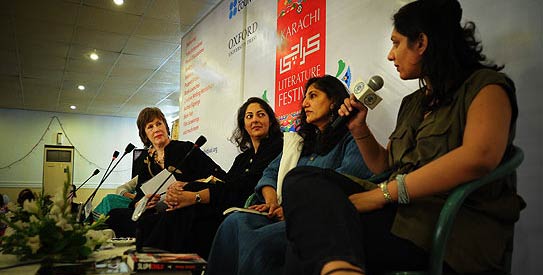
Women writing for women have always been considered a taboo in Pakistan, primarily because the vast majority of the male population believe that books written by women on women are targeted to ‘blame’ the male gender for victimizing them.
Being an audience of one of the sessions aimed towards solving the so-called myth of gender biased writing in Pakistan, I feel it highly important to raise some ponderable points.
Bina Shah, the writer of many books worth reading, including ‘Slum Child’, highlighted the essential components of men not being an active part of Shah’s readership.
“There is a lot more to this ‘phenomenon’ than is actually decipherable by many people and critiques of feminine writing. Men write about power, wars and politics which more is happening whereas women write about low-profile issues which are labeled as’ Chiclet’. It’s a masculine and feminine tussle,” said Bina Shah.
“I have never seen a man in Pakistan who would be interested to read Jane Austen,” Shah added.
Nafisa Haji, another critically acclaimed author of books such as ‘Sweetness of Tears’, differed and said “I generally do not appreciate people labeling my work because categories clearly send out negative vibes to the male readership,”
“We are doing a favor to the entire humanity which is why I do not want to categorize my work,” she added.
Moreover, Haji narrated an incident in which she reminisced about her brother being asked to leave the room where feminine issues were being discussed. She believes that the exclusion from feminine orbit instigate men to shy away from feminine writing and issues.
Haji believes labeling literature means excluding the greater half of the society from seeking knowledge from her work.
All the participating authors believed that foreign exposure has provided them with an added advantage and have equipped them with tools to address the prevalent issues with a perspective of an outsider.
“I was confused when I was growing up because I looked like some people and spoke like other people. Writing for me was an outlet to sort out my confusion about my identity,” said Shah.
For many authors such as Shah, writing is a form of therapy – a struggle to ‘gel in’ with the society which alienates them on the basis of gender and language.
Perhaps this is one of the many reasons why many female authors highlight issues pertaining to women rights as this still remains the most controversial and least publicised issues in Pakistan.
One could attribute the ‘uprising’ of women’s literature to various factors, but to me the most apparent issue is the fact that it is extremely difficult for a Pakistani woman to voice her opinion without being judged. Unless we eliminate the aforementioned fact, ‘female literature’ will remain under-read.


























