



 0
0

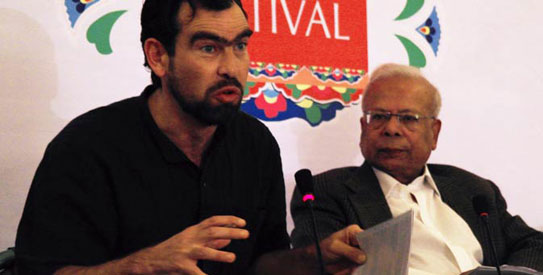
Being the current epicenter of the Arab Spring, Syria was justifiably the main theme at a discussion on last year’s revolution at the Karachi Literature Festival.
British-Syrian novelist and journalist, Robin Yassin-Kassab highlighted that human issues sparked the wave of revolution that swept the Middle East and North America, contrary to popular interpretation of its political and economic engine.
“The main demand of the people wasn’t economic or political; it was something more human than that. It was for dignity,” he said.
Citing examples of Tunisia, where the revolution first ignited, Yassin-Kassab attached reasons of deflated human dignity that led to Mohamed Bouazizi, a street vendor, to set himself ablaze.
This concept of reacting to inhumane treatment of citizens by the government and standing up to bullies in a police state was then echoed across the Arab world in the form of protests. In Syria, the initial demonstration started as a mere response to inhumanity when a policeman beat up the son of a market trader. Demonstrators chanted slogans that the Syrian people would not be humiliated.
“They are not asking for the regime to be changed, they are not asking for complete radical re-haul, just a little more respect,” he said.
According to Yassin-Kassab, the Syrian regime’s response to these cries, which merely exacerbated the situation and caused death tolls to skyrocket, reflected their ‘stupidity.’
President Bashar Al Assad, despite having witnessed the ouster of ex-Egyptian president Hosni Mubarak, had missed the chance to make strategic changes that would keep him in power, in accordance to those taking place around the world. Had he seized the opportunity to pre-empt the chaos with a promise of democratic reform, Yassin-Kassab predicts that the Syrian people, with whom President Assad was largely popular, would have been appeased.
Elsewhere in the Arab world, the ouster of the various regimental leaders marks the dawn of a new era. As elections take place in Tunisia and Egypt, a new phenomenon that is attracting global attention is the success of Islamist parties at the forefront of the elections.
Apart from their supporters, many others on the international stage are concerned about the rise of Islamist parties such as the Muslim Brotherhood and Salafis. For the United States, the fear of Islamist parties rising to power stems from the foreign policies that these parties might pursue that might be unlike their pro-western authoritarian predecessors.
According to Stefan Weidner, a German writer and journalist, the young people who initiated the revolution in Egypt did not feel represented by the result of the elections, which favoured the Islamists.
From discussions with activists, Weidner learned of a speculation that there is a silent secret coalition between the military and the Muslim Brotherhood.
“Both are conservative and both are not really interested in civil society and both are not really interested in opening up the society, which is why they most probably work together,” Weidner explained.
While he expressed his lack of optimism of a country led by Islamists, Weidner is confident that the young, secular revolutionists will eventually get organised and work towards a better Egypt for the people.




























