0
0

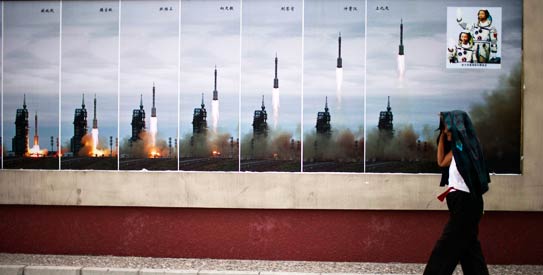
BEIJING:China will continue to push its ambitious space programme with launch of its manned Shenzhou-9 spacecraft between June and August this year, as well as conduct a space rendezvous and docking mission with the orbiting Tiangong-1 space lab module, a spokesman for China's manned space program said on Friday.
The space docking mission will be manually conducted by astronauts, giving China another chance to test its docking technology, the spokesman said.
“The new space docking mission is ... another chance for China to test its docking technology,” Xinhua cited an unnamed spokesman for China's manned space programme as saying.
“The three crew members ... will enter the Tiangong 1 vehicle to live and work there, conducting space science experiments,” it added, without elaborating.
The Shenzhou-9's three crew members will board the Tiangong-1 after the docking is completed, living there and conducting scientific experiments.
An evaluation of the program was carried out following a previous rendezvous by the Tiangong-1 and the unmanned Shenzhou-8 spacecraft, showing that all relevant systems are in good condition and are ready for a manned docking, the Xinhua news quoted the spokesman.
The orbiting Tiangong-1 is ready to accommodate the astronauts, and the Shenzhou-9 spacecraft and its carrier rocket, the Long-March II-F, are undergoing final checks, the spokesman said.
The Tiangong-1 went into space on Sept 29, 2011, docking with the Shenzhou-8 spacecraft to complete China's first space docking mission just over a month later.
It will be China's fourth manned space mission since 2003, when astronaut Yang Liwei orbited Earth 14 times, becoming the country's first man in space.
China aims to have a fully fledged space station by about 2020.
However, it is still far from catching up with the established space superpowers: the United States and Russia.
Russia, the United States and other countries jointly operate the 400-tonne International Space Station, to which China does not belong.